
They sold you flexibility. They sold you entrepreneurship. They sold you the freedom to be your own boss, set your own hours, and earn money on your own terms.
They lied.
The gig economy—dominated by platforms like Uber, Lyft, DoorDash, and Instacart—isn’t about worker freedom. It’s about systematically stripping workers of protections, benefits, and dignity while extracting maximum value through algorithmic management and legal manipulation.
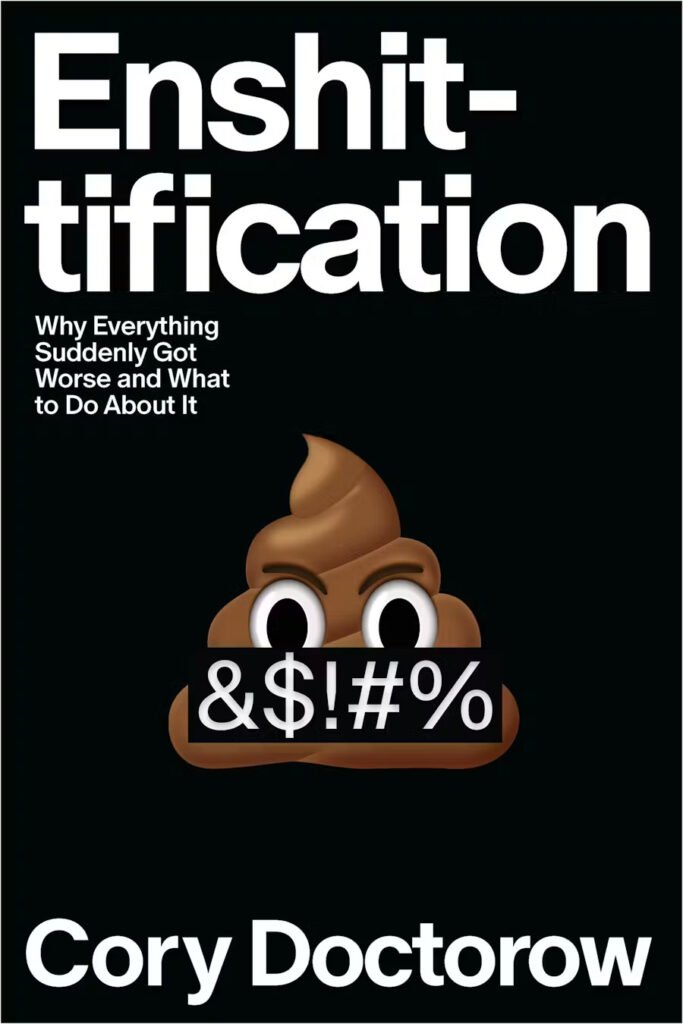
In Enshittification, Cory Doctorow exposes how gig platforms use technology to create a new class of workers with all the obligations of employment and none of the protections—workers who can be surveilled, controlled, and discarded at will while platforms profit from their labor.
The Flexibility Scam: Control Without Responsibility
Uber’s pitch to drivers is seductive: drive when you want, as much or as little as you want, using your own car on your own schedule. You’re an independent contractor, an entrepreneur, a small business owner.
This is a legal fiction designed to evade labor law.
In reality, Uber exercises comprehensive control over drivers:
Algorithmic Wage Setting: Uber sets the rates drivers earn. Drivers have no negotiating power, no input into pricing, no ability to charge what they think their labor is worth. Uber unilaterally decides compensation through opaque algorithms that change without notice or explanation.
Route and Customer Assignment: Uber decides which rides drivers get, when they get them, and where they go. Drivers can’t see destination information before accepting rides. They can’t filter for profitable routes or avoid money-losing trips. The algorithm assigns work; drivers execute.
Performance Surveillance: Uber monitors drivers constantly—tracking speed, braking patterns, route choices, acceptance rates, cancellation rates, and customer ratings. This surveillance determines which drivers get priority for lucrative rides and which get deactivated.
Arbitrary Termination: Uber can deactivate drivers instantly without explanation, appeal, or due process. Your livelihood depends on algorithmic judgment that you can’t see, challenge, or understand. You’re not an independent contractor—you’re an at-will employee without employee protections.
This is the worst of both worlds: comprehensive employer control combined with zero employer responsibility.
Algorithmic Wage Discrimination: The “Twiddling” Exploitation
Doctorow introduces the concept of “twiddling”—platforms using algorithms to manipulate workers in real time, extracting maximum value while minimizing compensation.
Uber’s algorithmic wage discrimination operates through several mechanisms:
Dynamic Pricing That Doesn’t Benefit Drivers: When demand surges, Uber increases what customers pay through “surge pricing.” Theoretically, this should increase driver earnings to incentivize more drivers to work. But Uber keeps an increasing percentage of surge fares for itself, meaning customers pay significantly more while drivers see minimal increases.
Bait and Switch Algorithms: Uber shows drivers estimated earnings for trips that consistently prove lower than actual earnings. The algorithm baits drivers into accepting rides by overpromising compensation, then pays less than advertised. Drivers can’t challenge these discrepancies individually—and Uber’s arbitration clauses prevent class-action lawsuits.
Strategic Ride Assignment: Uber’s algorithm assigns long pickups, short rides, and money-losing trips to drivers who can least afford to refuse them—drivers who need income desperately enough to accept bad terms. Meanwhile, profitable rides go to drivers with better acceptance rates, creating a coercive system where drivers must accept losing propositions to access winning ones.
Opaque Route Optimization: Uber sometimes pays drivers for slightly longer routes than necessary, capturing the extra customer payment while the driver earns pennies more. Other times, it routes drivers inefficiently while paying for the shorter route, pocketing the difference. Drivers have no visibility into these manipulations.
Waiting Time Exploitation: Drivers spend enormous amounts of time waiting for ride requests, driving to pickup locations, and navigating to surge areas. Uber pays nothing for this “unengaged time”—even though waiting is a direct requirement of the job and drivers can’t work elsewhere while waiting.
The Misclassification Scam: Evading Employment Law
The gig economy’s fundamental trick is misclassifying employees as independent contractors. This isn’t about semantics—it’s about stripping workers of legal protections:
No Minimum Wage: As contractors, gig workers aren’t guaranteed minimum wage. Studies consistently show that after expenses (gas, maintenance, insurance, depreciation), most gig workers earn well below minimum wage, sometimes as low as $5-7 per hour.
No Overtime: Work 60 hours? 80 hours? No overtime pay. No time-and-a-half. No premium for working holidays or nights. Platforms profit from unlimited worker hours at flat rates.
No Benefits: No health insurance. No paid sick leave. No workers’ compensation for injuries on the job. No unemployment insurance when platforms deactivate workers. No retirement contributions. Nothing.
No Workplace Protections: No protection against discrimination based on race, gender, disability, or age. No harassment protections. No right to organize. No collective bargaining. No safety regulations beyond basic traffic laws.
No Employer Expenses: Workers pay for vehicles, fuel, maintenance, insurance, phones, and data plans. These business expenses would normally be employer costs. Instead, platforms externalize all capital costs onto workers while capturing all profits.
This saves platforms an estimated 30% on labor costs compared to treating workers as employees. That 30% doesn’t go to customers through lower prices or to workers through higher wages—it goes to executives and shareholders as pure profit extracted through legal manipulation.
The Human Cost: Exploitation by Design
When Doctorow discusses gig worker exploitation, he’s not describing unintended consequences—he’s describing the business model’s core mechanism.
Poverty Wages: Human Rights Watch documented that gig workers in Texas earned median wages of $7.80 per hour after expenses—far below the minimum wage. Some workers earned as little as $2.50 per hour. This isn’t failure—it’s the intended result of worker misclassification.
Physical Harm Without Protection: Gig workers suffer injuries, car accidents, and deaths on the job. Without workers’ compensation, injured workers lose income and face medical bankruptcy. When Uber driver Dede Fredy died in a fatal crash in 2020, his family received no compensation, no death benefits, nothing. Uber disclaimed all responsibility because Fredy was a “contractor.”
Algorithmic Control and Psychological Harm: Constant surveillance, arbitrary deactivation, and algorithmic manipulation create enormous stress. Workers describe feeling trapped, exploited, and helpless—unable to predict earnings, unable to challenge unfair treatment, unable to leave because they’ve invested in vehicles and depend on income.
Racial Exploitation: Gig workers are disproportionately immigrants and people of color. Combined, Black and Latinx workers make up 42% of app-based workers despite representing only 29% of the total workforce. Platforms deliberately target vulnerable populations who have fewer employment options and less power to resist exploitation.
The Legislative Capture: Buying Laws to Protect Exploitation
Faced with court rulings and legislation threatening their misclassification scam, gig platforms deployed massive lobbying campaigns to rewrite labor law.
State Carveouts: Between 2014 and 2017, Uber successfully lobbied more than 40 states to pass laws locking rideshare drivers into independent contractor status, preventing them from claiming employee rights.
California Prop 22: When California passed AB5, classifying gig workers as employees entitled to labor protections, Uber, Lyft, and DoorDash spent over $200 million on Proposition 22—a ballot measure written by the companies to exempt themselves from labor law. They won through deceptive advertising that claimed the measure protected driver flexibility and benefits.
The “Third Way” Scam: Platforms now push legislation claiming to create a “third category” of worker—neither employee nor contractor, but something in between. This is code for “workers with some minimal benefits but none of the actual protections or organizing rights that employment provides.”
These lobbying efforts don’t just harm gig workers—they threaten all workers. If platforms can successfully carve out entire categories of workers from labor protections, every industry will follow. The “gigification” of work becomes a model for stripping protections from workers economy-wide.
It’s Not Wage Theft If You Do It With an App
Doctorow’s chapter title captures the absurdity: behavior that would be criminal wage theft if done by a traditional employer becomes legal “innovation” when mediated by an app.
If a restaurant hired servers, controlled their schedules, monitored their performance, set their wages unilaterally, and then claimed they were independent contractors to avoid paying minimum wage, benefits, and payroll taxes, prosecutors would file criminal charges for wage theft.
But when Uber does exactly that through an app, courts spend years debating whether drivers are really employees. The algorithm obscures the employment relationship while intensifying employer control.
This isn’t legal ambiguity—it’s regulatory capture aided by technology. Platforms weaponize digital interfaces to evade laws that clearly apply to their business practices.
What Needs to Change: Ending the Gig Economy Lie
Doctorow’s prescription for fixing gig economy exploitation is straightforward:
Classify Workers as Employees: Apply the economic reality test properly. If a company controls work assignments, sets wages, monitors performance, and can terminate workers, those workers are employees. Full stop. The existence of an app doesn’t change the employment relationship.
Enforce Minimum Wage: Guarantee gig workers earn at least minimum wage for all time worked—including waiting time, travel to pickups, and time spent dealing with platform administration.
Mandate Benefits: Require platforms to provide health insurance, workers’ compensation, unemployment insurance, and retirement benefits like any other employer.
Ban Algorithmic Wage Discrimination: Require transparency in pay algorithms. Prohibit platforms from showing different workers different rates for identical work. Guarantee workers can see and challenge pay calculations.
Enable Worker Organizing: Recognize gig workers’ right to organize, bargain collectively, and strike. Ban mandatory arbitration clauses that prevent workers from filing class-action lawsuits.
Hold Platforms Liable: Create corporate liability for worker harm, safety violations, and employment law violations. Platforms shouldn’t be allowed to disclaim responsibility for workers they directly control.
What You Need to Know Right Now
The gig economy isn’t the future of work—it’s a regression to pre-New Deal labor exploitation enabled by apps and algorithmic management.
If you’re a gig worker: You’re not failing. The system is designed to exploit you. Your struggle to earn decent wages isn’t because you’re not working hard enough—it’s because platforms extract maximum value while paying minimum compensation.
If you use gig services: Understand that your convenience comes at the cost of worker exploitation. Tipping well helps individual workers but doesn’t fix systemic exploitation. Supporting worker organizing and policy changes does.
If you’re a policymaker: Don’t fall for the “third way” rhetoric. Employment law exists for good reasons. Apply it.
The platforms claim that treating workers as employees would destroy flexibility and innovation. This is propaganda. Traditional taxi companies employed drivers while allowing flexible scheduling. Nothing about employment status prevents flexible work arrangements—but employment status does prevent platforms from evading all responsibility for workers.
The choice isn’t between exploitation and rigidity. The choice is between allowing platforms to profit from worker abuse or requiring them to follow the same labor laws as every other employer.
Doctorow makes clear: algorithmic management doesn’t create new legal categories. It’s just union busting with source code. And we already have laws against that—if we’re willing to enforce them.
Related posts:
 Platform Capitalism: How Digital Monopolies Extract Value From Your Life
 Your Job Is to Get a Better Job: A Career Philosophy Built on Leverage
 What Is Enshittification? Why Every Platform Gets Worse
 Surveillance Capitalism Explained: Why Your Data Is So Profitable
 Will AI Take All Jobs? What 20–30% Unemployment Would Actually Mean