
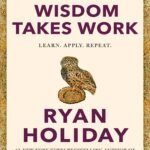
In a world of trending opinions, viral takes, and algorithmic echo chambers, the ability to think for yourself has become both rarer and more valuable than ever. Ryan Holiday’s Wisdom Takes Work confronts a troubling reality: most people don’t actually think—they echo, repeat, and conform.
This isn’t an accident. Modern society is specifically designed to discourage independent thought. Social media rewards consensus. News outlets amplify outrage. Educational systems prioritize memorization over critical thinking. The result? A population that mistakes knowing what everyone else thinks for thinking itself.
But wisdom, Holiday argues, requires something different. It demands the courage to stand apart, to question consensus, and to follow reason wherever it leads—even when it leads you away from the crowd.
The Seduction of Consensus
Why is independent thinking so difficult? Holiday explores the psychological forces that pull us toward groupthink, drawing from both ancient philosophy and modern behavioral science.
Humans are social creatures who crave belonging. Our ancestors survived by fitting into tribes. Those who went against the group risked exile and death. This evolutionary programming remains active today, creating powerful pressure to conform even when conformity contradicts truth.
Disagreeing with others feels dangerous. When you express an unpopular opinion, you risk social punishment—mockery, ostracism, or worse. Your brain perceives this as a genuine threat, triggering the same fear response as physical danger. The easy path is to nod along, to agree, to blend in.
Consensus feels like wisdom. If everyone believes something, it seems more likely to be true. This is the “argumentum ad populum” fallacy—the false assumption that popular opinions must be correct. Holiday notes that history’s greatest atrocities were committed by people following the crowd, convinced that majority opinion validated their actions.
What It Actually Means to Think for Yourself
Thinking for yourself doesn’t mean reflexively opposing popular opinion or embracing contrarianism for its own sake. Holiday is explicit about this in Wisdom Takes Work—genuine independent thought isn’t about being different; it’s about being truthful.
Independent thinking means examining evidence directly rather than accepting secondhand interpretations. When everyone is talking about a news story, do you read the primary sources or just the commentary? When a topic dominates social media, do you investigate or just absorb the prevailing narrative?
It means questioning your own beliefs as rigorously as you question others’. True independence requires self-skepticism. Your own thoughts deserve the same critical examination you’d apply to anyone else’s opinions. This is what separates genuine independent thinking from stubborn bias.
It means accepting uncertainty when evidence is insufficient. Groupthink offers certainty—the comfort of shared conviction. Independent thinking often leads to ambiguity, to “I don’t know,” to suspended judgment. Holiday emphasizes that wisdom involves recognizing the limits of your knowledge.
The Historical Models: Thinkers Who Stood Alone
Holiday fills Wisdom Takes Work with examples of individuals who thought for themselves despite enormous pressure to conform. These aren’t just inspirational stories—they’re case studies in what independent thinking actually requires.
Socrates questioned Athens when Athens was at its most powerful and proud. He challenged the city’s cherished beliefs, exposed the ignorance of its supposed wise men, and insisted on pursuing truth regardless of social consequences. The Athenians sentenced him to death for this independence. He chose execution over intellectual surrender.
Galileo maintained that the Earth moved around the Sun when the Church, the universities, and popular opinion all insisted otherwise. He faced persecution, house arrest, and the threat of torture. Yet he couldn’t unsee what his observations had revealed. “And yet it moves,” he reportedly said—a perfect expression of thinking for yourself.
Marcus Aurelius, despite being emperor of Rome, constantly reminded himself to question his assumptions and not be swept along by court politics and flattery. His Meditations is essentially a running dialogue with himself, challenging his own thoughts and resisting the pressure to believe what powerful people wanted him to believe.
What united these thinkers wasn’t rebelliousness—it was commitment to truth over comfort, to reality over consensus.
The Modern Threat: Information Overload and Echo Chambers
Holiday argues that independent thinking faces unique challenges in the digital age. Never before have humans been subjected to such a constant barrage of opinions, interpretations, and takes.
Social media algorithms create filter bubbles. You see content that confirms your existing beliefs and shields you from challenging perspectives. This creates the illusion of consensus—everyone in your feed seems to agree with you, so you must be right.
News media prioritizes engagement over truth. Outrage spreads faster than nuance. Confirmation beats contradiction. Media outlets discovered that telling people what they want to hear is more profitable than challenging their assumptions. Independent thinking requires deliberately seeking out information that doesn’t trigger easy emotional responses.
Expert opinion has become weaponized. Both sides of every debate now have “experts” supporting their position. This isn’t because all expertise is equally valid—it’s because cherry-picking credentialed voices is easier than evaluating arguments on their merits. Holiday warns against the appeal to authority fallacy: just because someone has a degree doesn’t make them right about everything.
Practical Strategies for Independent Thinking
How do you actually develop the ability to think for yourself? Holiday offers concrete practices drawn from his own experience and the wisdom tradition:
Consume primary sources directly. Don’t just read what people say about a book, speech, or study—read the actual thing. Holiday emphasizes how often interpretations distort or completely misrepresent original sources. When everyone is discussing a topic, go to the source material. You’ll often discover the consensus narrative is incomplete or wrong.
Seek out intelligent opposition. Find the smartest people who disagree with you and seriously engage with their arguments. Holiday doesn’t mean finding straw men to knock down—he means genuinely grappling with the strongest version of opposing views. This is how you test your thinking and discover its weaknesses.
Write to clarify your thoughts. Holiday is a strong advocate for writing as a thinking tool. When you force yourself to articulate your position in writing, you can’t hide behind vague feelings or uncritical acceptance. The act of writing exposes fuzzy thinking and forces clarity.
Implement a “cooling off” period before forming opinions. When a new controversy erupts or a hot take goes viral, resist the urge to immediately form and express an opinion. Holiday suggests waiting at least 24 hours before deciding what you think. This simple practice prevents you from thoughtlessly adopting the first narrative you encounter.
Regularly change your mind on something. Make it a practice to actively look for beliefs you should revise. Holiday keeps a running list of things he was wrong about and publishes them periodically. This trains your ego to accept correction and signals to yourself that changing your mind is strength, not weakness.
The Social Cost of Independence
Holiday doesn’t sugarcoat the challenges in Wisdom Takes Work. Thinking for yourself often means standing alone, facing criticism, and accepting that some people won’t like you.
You’ll lose friends who value conformity over truth. Some relationships depend on shared opinions. When you break from consensus, these relationships fracture. Holiday notes this isn’t necessarily bad—it reveals who valued your presence versus who valued your agreement.
You’ll be misunderstood and misrepresented. When you don’t fit neatly into established camps, both sides will attack you. The left will call you right-wing; the right will call you left-wing. This is actually a good sign—it means you’re thinking rather than tribally aligning.
You’ll second-guess yourself constantly. When everyone around you believes X and you believe Y, you’ll wonder if you’re the one who’s wrong. Sometimes you will be. But the discomfort of uncertainty is the price of intellectual independence.
Holiday shares personal stories of the cost of independence, including professional consequences and online harassment. He’s honest about the difficulty while maintaining that the alternative—surrendering your mind to groupthink—is far worse.
Independent Thinking Versus Contrarianism
One of the most important distinctions Holiday makes is between genuine independent thinking and simple contrarianism. They look similar but are fundamentally different.
Contrarians automatically oppose popular opinion. If everyone says X, the contrarian says not-X, regardless of evidence. This isn’t thinking—it’s reactive posturing. True independent thinkers sometimes agree with consensus when evidence supports it.
Contrarians care about being different. Independent thinkers care about being right. The motivation matters. If your goal is to stand out or seem smarter than others, you’ve replaced one form of groupthink with another.
Contrarians are predictable. Once you know someone is a contrarian, you can predict their positions simply by knowing what’s popular. True independent thinkers are unpredictable because they follow evidence rather than social positioning.
Holiday emphasizes that wisdom requires intellectual humility. Sometimes the crowd is right. Sometimes traditional wisdom holds valuable truth. Independent thinking means being willing to agree with others when appropriate, just as it means being willing to dissent when necessary.
The Philosophical Foundation: First Principles Thinking
At the core of independent thinking is what Holiday calls “first principles thinking”—a method popularized by Elon Musk but originating with ancient philosophers like Aristotle.
First principles thinking means breaking down beliefs to their foundational assumptions. Instead of accepting claims at face value, you ask: What are the basic, irreducible truths underlying this belief? What do we actually know versus what we’re assuming?
For example, instead of accepting that “everyone needs a college degree to succeed,” first principles thinking questions: What is success? What skills does it require? Is formal education the only way to acquire those skills? What evidence supports the necessity of a degree?
This approach often reveals that conventional wisdom rests on outdated assumptions or faulty logic. Holiday argues that most groupthink persists because people never question the foundational premises—they just build opinions on top of unexamined assumptions.
Building Your Truth-Seeking Practice
Holiday concludes this section of Wisdom Takes Work with a framework for developing independent thinking as a daily practice rather than occasional rebellion:
Start small with low-stakes disagreement. You don’t need to publicly challenge major societal assumptions right away. Begin by questioning minor claims, testing arguments in private journals, or discussing unpopular views with trusted friends. Build your independence muscle gradually.
Create an information diet that challenges you. Actively curate sources that disagree with your current views. Subscribe to publications from different political perspectives. Read books by people whose conclusions you reject. Expose yourself to dissonance deliberately.
Develop your bullshit detector. Holiday recommends studying logical fallacies, cognitive biases, and persuasion techniques. When you understand how manipulation works, you become harder to manipulate.
Find or create communities that value truth over agreement. Seek out people who can disagree respectfully, who update their beliefs based on evidence, and who value getting it right over being right. These relationships support independent thinking rather than punishing it.
The Reward: Freedom and Wisdom
Why go through all this difficulty? Holiday’s answer is simple: because intellectual independence is freedom, and freedom is necessary for wisdom.
When you think for yourself, you’re no longer controlled by others’ opinions. You’re not buffeted by media narratives or social pressure. You develop the internal compass that guides all wise action.
This doesn’t mean isolation or arrogance. Independent thinkers can still learn from others, change their minds, and acknowledge error. But they do so on their own terms, based on evidence and reason rather than social pressure.
As Holiday powerfully argues in Wisdom Takes Work, the ability to think for yourself isn’t a luxury for intellectuals—it’s a necessity for anyone pursuing wisdom. In a world designed to control your thoughts, reclaiming your mind is the first step toward living wisely.
Ryan Holiday’s Wisdom Takes Work: The Ultimate Guide to Ancient Wisdom for Modern Life

Related posts:
 Ryan Holiday’s “Wisdom Takes Work”: Why Philosophy Only Matters When It’s Practiced
 Who is Ryan Holiday and His Impact on Philosophy Presented By Masculine Synergy
 Stoic Wisdom: How Hardship Builds Character (Wisdom Takes Work by Ryan Holiday)
 Mentorship Tips That Actually Work (And Why Most Advice Fails)
 How to Improve Your Curiosity and Ask Better Questions