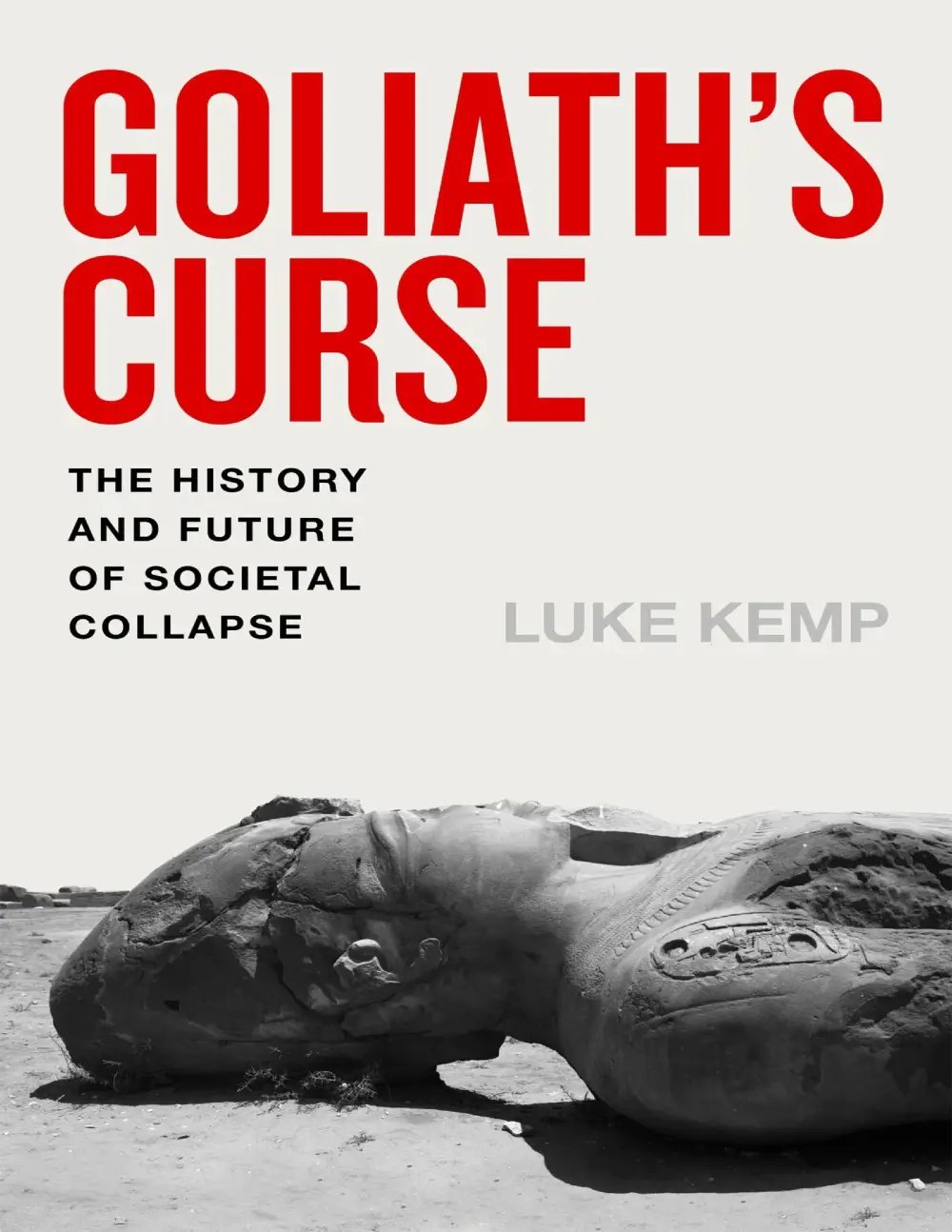
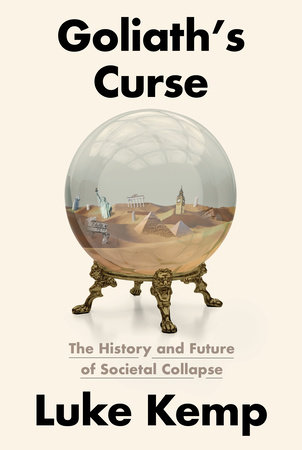
Luke Kemp‘s “Goliath’s Curse: The History and Future of Societal Collapse” presents a groundbreaking analysis of why civilizations throughout history have fallen—and why modern society faces unprecedented collapse risks. As a Senior Research Associate at Cambridge University’s Centre for the Study of Existential Risk, Kemp brings rigorous scholarship to one of humanity’s most urgent questions. This comprehensive summary distills the book’s 25 most critical insights, each supported by key concepts from Kemp’s research.

Understanding Goliath‘s Curse
Before diving into the takeaways, it’s essential to understand what Kemp means by “Goliath’s Curse.” Throughout the book, Kemp demonstrates that large, powerful states—the Goliaths of history—contain the seeds of their own destruction. Power concentration creates vulnerabilities. Complexity breeds fragility. Success generates complacency. This curse has affected every great civilization from ancient Mesopotamia to modern superpowers.
25 Key Takeaways From Goliath’s Curse
1. All States Eventually End—The Average Lifespan Is Just 326 Years
The historical data is stark: no state has lasted forever, and most collapse far sooner than we assume. Mega-empires covering over a million square kilometers are even more fragile, lasting an average of only 155 years.
Key Insight: Kemp notes that “the average lifespan of a state is 326 years,” reminding us that the United States, at under 250 years old, remains within the danger zone where historical states began terminal decline.
2. Hunter-Gatherers Lived Better Than Early Farmers
Contrary to popular belief, the agricultural revolution didn’t improve human welfare. Archaeological evidence shows early farmers suffered shorter lifespans, worse health, harder labor, and greater inequality than their foraging ancestors.
Key Insight: The transition to agriculture represents what Kemp describes as a trap—once populations grew dependent on farming, they couldn’t return to foraging even though it meant accepting worse living conditions.
3. Societal Collapse Isn’t Always Catastrophic for Common People
While collapse devastates elites who lose wealth and power, ordinary people often experience relief when extractive states fall. Without tax collectors and forced labor obligations, populations can consume more of what they produce.
Key Insight: Kemp emphasizes that “collapse affected elites far more severely than ordinary people,” challenging narratives that portray all collapses as universal disasters.
4. Power Comes in Four Forms That Can All Collapse
Human history represents a struggle over four types of power: control of decision-making (government), control of resources (food, water), control through violence (military), and control of information (bureaucracy, media, technology).
Key Insight: Kemp frames history as fundamentally about power struggles, noting that “power depends on who you are controlling—the size, skills, and health of the population.”
5. The Bronze Age Collapse Shows How Interconnected Systems Fail
Around 1200 BCE, the interconnected Bronze Age Mediterranean world collapsed within decades. This first experiment in globalization demonstrates how tightly coupled systems propagate failures rapidly across entire networks.
Key Insight: The Bronze Age collapse illustrates what Kemp calls “systems collapse”—when multiple interdependent components fail simultaneously, overwhelming any capacity for recovery.
6. Climate Change Has Toppled More Empires Than Barbarians
Drought, environmental degradation, and climate shifts have played decisive roles in collapse throughout history. The Maya, Akkadian, and many other civilizations fell primarily due to environmental stresses rather than military conquest.
Key Insight: Kemp documents how “severe drought coinciding with Maya collapses” reveals that environmental factors often prove more destructive than warfare.
7. Modern Civilization Faces Truly Existential Threats for the First Time
Unlike historical collapses that remained regional, modern threats like climate change, nuclear weapons, and artificial intelligence could destroy civilization globally and permanently.
Key Insight: These represent what Kemp calls “existential risks”—threats that could permanently destroy humanity’s long-term potential, something no previous civilization faced.
8. We May Have Consumed the Resources Needed to Rebuild After Collapse
The “rungless ladder” concept suggests that if industrial civilization collapses, humanity may lack easily accessible resources—surface coal, iron ore, old-growth forests—to rebuild technological society.
Key Insight: Kemp warns we face a “one-shot civilization” problem—we’ve used one-time geological resource endowments that enabled our development and won’t be available for future recovery.
9. Extreme Inequality Destabilizes Even Wealthy Societies
Throughout history, extreme wealth concentration and elite extraction from broader populations have created internal tensions that undermine resilience and trigger collapse.
Key Insight: Historical evidence shows that societies collapse when “elite extraction exceeded populations’ tolerance,” regardless of overall wealth levels.
10. Agriculture Created Hierarchy, Not Human Nature
For 95% of human history in hunter-gatherer societies, humans lived relatively egalitarian lives. Hierarchy and inequality emerged with agriculture and state formation, not from innate human tendencies.
Key Insight: Kemp documents how foraging societies “developed cultural mechanisms actively resisting inequality,” including ridicule of boastful individuals and consensus decision-making.
11. The First States Often Arose Through Violence and Coercion
Early states didn’t emerge from voluntary cooperation but frequently through military groups conquering agricultural populations and establishing themselves as ruling classes.
Key Insight: State formation often involved what Kemp describes as “subjugation of farming populations by militarized groups,” challenging narratives of states as social contracts.
12. Rome’s Fall Was Actually a Transformation, Not Total Collapse
Unlike civilizations that vanished completely, Rome experienced gradual transformation. The Eastern Byzantine Empire continued for another millennium, while Western European kingdoms maintained Roman institutions and cultural elements.
Key Insight: Kemp argues that Rome’s “fall” should be understood as “transformation rather than simple collapse,” with significant institutional and cultural continuity.
13. Some Collapses Are Permanent—Others Create Lasting Legacies
Cahokia vanished so completely that indigenous peoples had no oral traditions about it. Rome’s legacy endured for centuries. Geography, cultural factors, and collapse speed determine whether civilizations are remembered or forgotten.
Key Insight: The comparison between Rome and Cahokia reveals that “Cahokia’s collapse was terminal, while Rome’s culture and institutions lived on.”
14. Elite Overproduction Triggers Internal Conflict
When societies produce more elite aspirants than positions available, competition intensifies and destabilizes political systems. Late Republican Rome exemplifies this dynamic.
Key Insight: Kemp discusses how “elite overproduction”—too many ambitious individuals competing for limited elite positions—creates intra-elite conflict that destabilizes entire societies.
15. Environmental Degradation Often Results From Agriculture Intensification
As populations grow, societies intensify agriculture through deforestation, irrigation expansion, and shortened fallows. These boost short-term yields while undermining long-term sustainability through soil degradation and salinization.
Key Insight: The Akkadian Empire’s collapse shows how “irrigation caused soil salinization—salt accumulation making land infertile”—a pattern repeated throughout history.
16. Moderate Environmental Stress Builds Resilience
Societies facing periodic challenges develop adaptive strategies—grain storage, resource sharing, crisis management knowledge. Those experiencing constant stability or overwhelming disasters lack such preparation.
Key Insight: The “intermediate disturbance hypothesis” suggests that moderate challenges enhance resilience while extremes or absence of stress create vulnerability.
17. Nuclear Weapons Create Unprecedented Civilization-Ending Risks
Approximately 13,000 nuclear warheads exist globally, capable of destroying civilization within hours through direct effects and nuclear winter. Unlike natural disasters, nuclear war results entirely from human decisions.
Key Insight: Nuclear weapons represent what Kemp calls “fat tail risks”—low probability events with enormous consequences that accumulate over time.
18. Artificial Intelligence Development Creates Unpredictable Dangers
The prospect of artificial general intelligence matching or exceeding human capabilities raises profound control questions. Competitive pressures accelerate development while potentially compromising safety.
Key Insight: Kemp discusses the “alignment problem”—ensuring advanced AI systems pursue goals compatible with human welfare, which proves extraordinarily difficult.
19. Modern Systems Have “Death-Star Syndrome” Vulnerabilities
Like the fictional Death Star, modern infrastructure creates enormous capabilities alongside catastrophic single-point-of-failure vulnerabilities through interconnection and optimization for efficiency over resilience.
Key Insight: The concept describes how we’ve “optimized systems for performance rather than resilience,” which works brilliantly until it fails catastrophically.
20. Population Movements Often Accompanied Collapse
People “voted with their feet,” abandoning extractive states for more equitable arrangements. The “Vacant Quarter” around Cahokia and Zomia populations fleeing lowland states demonstrate intentional rejection of hierarchical systems.
Key Insight: Kemp documents how populations “simply leaving” represents a major collapse pattern, with people choosing mobile alternatives over oppressive settlements.
21. Writing and Literacy Often Disappeared After Collapse
The Bronze Age collapse erased literacy in several regions for centuries. Knowledge preserved only in palace archives vanished when those institutions burned, demonstrating information fragility.
Key Insight: Loss of literacy shows how “specialized knowledge concentrated in elite institutions” proves vulnerable to systemic disruption.
22. Chinese History Shows Collapse Needn’t Be Permanent
Unlike many civilizations, Chinese states repeatedly reconstituted after collapse. The cycle of imperial rise, fall, and renewal demonstrates that collapse patterns aren’t universal.
Key Insight: China’s history reveals that “collapse need not mean permanent dissolution,” suggesting certain cultural and geographic factors enable reconstruction.
23. Modern Technology Makes Recovery Harder, Not Easier
Unlike Bronze Age technology maintainable by village craftsmen, modern systems require vast integrated infrastructure. Losing these capabilities could mean permanent rather than temporary loss.
Key Insight: Kemp emphasizes that “modern technology differs fundamentally” from historical equivalents in requiring complex supply chains and specialized knowledge that can’t survive decentralized.
24. Climate Tipping Points Could Trigger Irreversible Changes
Unlike gradual environmental stresses that historical societies faced, modern climate change threatens tipping points—thresholds beyond which systems shift into new stable states irreversible on human timescales.
Key Insight: Potential tipping points in ice sheets, ocean circulation, and rainforests could trigger “irreversible” changes, representing qualitatively different threats than historical climate variability.
25. Avoiding Collapse Requires Active Management, Not Passive Hope
Existential risks don’t solve themselves. Preventing catastrophe demands sustained effort: rapid decarbonization, nuclear arms control, AI safety frameworks, and biotechnology governance.
Key Insight: Kemp argues that “preventing catastrophe requires active management,” emphasizing that civilization’s continuation depends on deliberate choices rather than inevitable progress.
Why Goliath’s Curse Matters Now
Luke Kemp’s “Goliath’s Curse” arrives at a critical moment in human history. As climate change accelerates, political polarization intensifies, and technological disruption accelerates, understanding historical collapse patterns becomes essential for navigating present dangers.
The book challenges comfortable assumptions about progress and permanence. We assume technological advancement guarantees continued prosperity. We believe modern knowledge protects us from mistakes that destroyed past civilizations. We hope that complexity and interconnection create stability rather than fragility.
Kemp demonstrates that these assumptions lack historical support. Every civilization that collapsed believed itself exceptional. Every fallen empire thought its power would endure. Every vanished culture assumed its achievements would persist. Yet most disappeared, leaving only ruins and cautionary tales.
Practical Applications of These Insights
Understanding collapse patterns helps societies recognize warning signs and implement corrections:
For Policy Makers: The book emphasizes building resilience through diversity and redundancy rather than optimizing purely for efficiency. Distributed energy generation, local food production, and decentralized systems survive disruptions better than centralized alternatives.
For Citizens: Kemp’s research highlights the importance of reducing inequality, maintaining social cohesion, and prioritizing long-term sustainability over short-term extraction. Democratic engagement becomes crucial for demanding policies addressing existential risks.
For Researchers: The interdisciplinary approach combining archaeology, history, climate science, and risk analysis provides frameworks for studying complex system failures and developing better predictive models.
For Future Generations: Perhaps most importantly, the book clarifies our obligations to those who will inherit whatever world we leave. The rungless ladder concept emphasizes that our choices determine not just immediate outcomes but humanity’s long-term potential.
Critical Reception and Impact
“Goliath’s Curse” has received acclaim from scholars and popular audiences alike for its rigorous research combined with accessible writing. Kemp synthesizes decades of archaeological findings, historical analysis, climate research, and contemporary risk assessment into a coherent narrative about human social organization.
The book’s contribution lies not just in documenting past collapses but in clarifying how modern risks differ fundamentally from historical threats. Climate change operates globally at unprecedented speed. Nuclear weapons enable near-instantaneous civilization destruction. Artificial intelligence creates control challenges unlike anything humans have faced. Synthetic biology democratizes catastrophic capabilities.
These novel threats require new frameworks for risk management, international cooperation, and long-term planning. Kemp provides conceptual tools for thinking about these challenges while avoiding both naive optimism and paralyzing despair.
How to Use This Summary
This summary provides a foundation for understanding “Goliath’s Curse,” but Kemp’s full text offers much greater depth, nuance, and supporting evidence. Each takeaway represents a complex argument developed across multiple chapters with extensive historical examples and contemporary analysis.
Readers interested in specific topics—environmental collapse factors, inequality’s role in destabilization, modern existential risks, or historical case studies—will find the complete book essential. Kemp includes detailed notes, references to academic literature, and discussions of scholarly debates that this summary necessarily omits.
For those deciding whether to read “Goliath’s Curse,” these takeaways demonstrate the book’s scope and significance. If understanding long-term civilizational risks matters to you—and it should matter to everyone concerned about humanity’s future—this book proves indispensable.
The Central Message
At its core, “Goliath’s Curse” delivers a message of informed urgency tempered by realistic hope. Yes, all great powers eventually fall. Yes, we face unprecedented threats. Yes, modern civilization’s complexity creates vulnerabilities our ancestors never confronted. But collapse isn’t inevitable, and understanding historical patterns helps us recognize and address present dangers.
The curse of Goliath—that concentrated power creates the conditions for its own destruction—needn’t doom humanity to endless cycles of rise and fall. By learning from past failures, acknowledging present vulnerabilities, and deliberately building more sustainable and equitable systems, we might break historical patterns.
Whether we succeed will determine not just our immediate future but the legacy we leave for all subsequent generations. As Kemp makes clear throughout “Goliath’s Curse,” we’re conducting an experiment with our only planet and our only civilization. Past societies could fail, learn, and try again. Our failures might prove terminal.
That realization should motivate serious engagement with the catastrophic threats we’ve created. Understanding why Goliaths fall helps us avoid becoming history’s next cautionary tale. Luke Kemp has
provided the knowledge. What we do with it remains to be determine
About the Author
Luke Kemp is a Senior Research Associate at the Centre for the Study of Existential Risk (CSER) at the University of Cambridge. He has lectured in economics and human geography, and his research has been covered by the BBC, The New York Times, and The New Yorker. His expertise spans historical collapse patterns, contemporary existential risks, and the intersection of environmental change and social systems.
Final Thoughts on Goliath’s Curse
“Goliath’s Curse: The History and Future of Societal Collapse” stands as essential reading for anyone concerned about civilization’s trajectory. Luke Kemp combines scholarly rigor with accessible prose, making complex ideas understandable without oversimplifying them.
The book’s greatest strength lies in connecting historical patterns to contemporary risks. By documenting how Bronze Age kingdoms, Maya cities, Chinese dynasties, and Roman power fell, Kemp illuminates dangers facing modern civilization. The parallels prove both illuminating and unsettling.
For readers seeking to understand why civilizations collapse, what separates permanent disappearance from enduring legacy, and how modern threats differ from historical challenges, “Goliath’s Curse” provides authoritative answers grounded in rigorous research. The 25 takeaways presented here only scratch the surface of the book’s insights.
In an era of accelerating change and mounting global challenges, Kemp’s work offers crucial perspective. We face choices that will determine not just current political and economic arrangements but humanity’s long-term survival and flourishing. Understanding the curse of Goliath—and how we might escape it—has never been more urgent.
Related posts:
 Why Civilizations Collapse: The Definitive Guide to Goliath’s Curse by Luke Kemp
 AI, Climate Change, and Nuclear War: The New Collapse Threats Ancient Empires Never Faced (Goliath’s Curse by Luke Kemp)
 From Maya to Rome: How Environmental Degradation Triggers Societal Collapse (Goliath’s Curse by Luke Kemp)
 Why Every Great Civilization Eventually Falls: Lessons from Goliath’s Curse by Luke Kemp
 Why Extreme Inequality Destroys Civilizations: The Goliath’s Curse Explained