
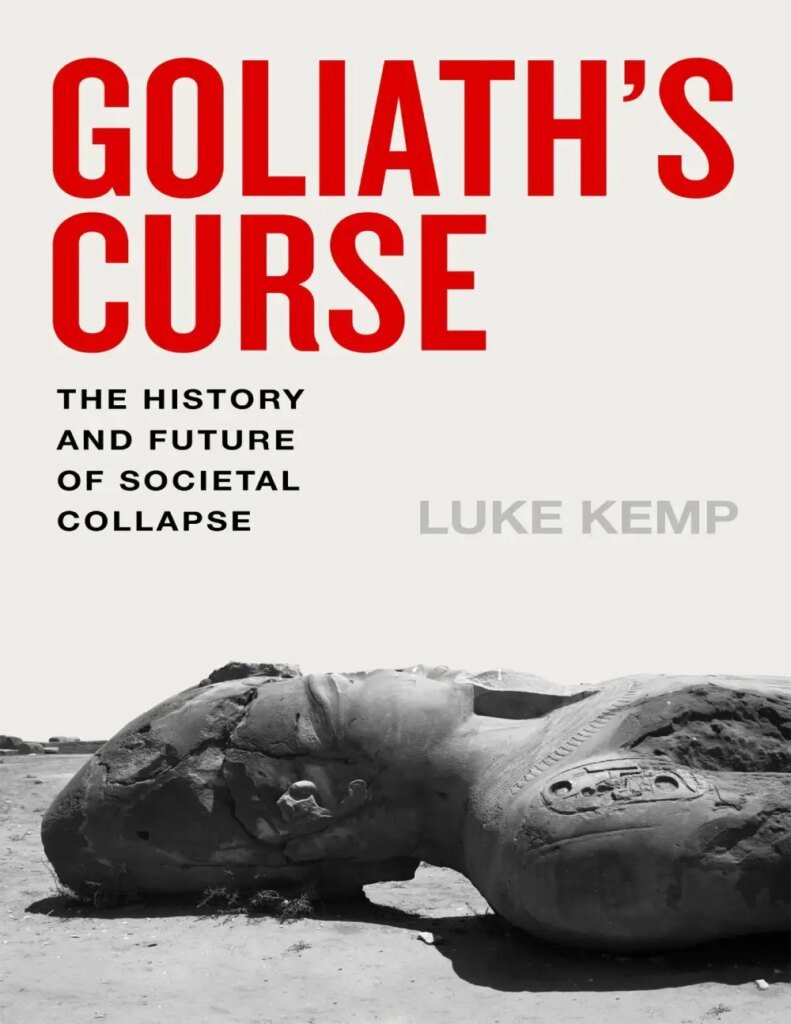
Throughout human history, mighty empires have risen from humble beginnings only to crumble into dust. From the pyramid cities of ancient Cahokia to the marble columns of Rome, from the Bronze Age Mediterranean to modern nation-states, the pattern repeats with unsettling regularity. In his groundbreaking book “Goliath’s Curse: The History and Future of Societal Collapse,” Luke Kemp, a Senior Research Associate at the Centre for the Study of Existential Risk at Cambridge University, unravels one of humanity’s most pressing questions: why do civilizations collapse, and what does this mean for our future?
The Anatomy of Power and Collapse
Kemp begins with a provocative premise: human history fundamentally represents a power struggle. Power manifests in four distinct forms that shape every society. First comes control of decision-making through centralized government. Second emerges control of critical resources like wheat and rice that populations depend upon daily. Third exists control through threats and violence. Fourth operates through information control, whether wielded by ancient priesthoods or modern technology companies.
These power structures define what Kemp calls “Goliath”—the states and empires that dominate human civilization. Yet here lies the curse: all Goliaths eventually fall. The average lifespan of a state throughout history spans just 326 years. Even more troubling, the largest empires covering over a million square kilometers prove most fragile, lasting merely 155 years on average.
When Civilizations Crumble: Defining Societal Collapse
Not every ending qualifies as collapse. When governments fail, we witness state collapse. When economies break down, we experience economic depression. When populations decline dramatically, we observe demographic busts. True societal collapse occurs when all these power systems crumble together in a relatively rapid and enduring manner.
Consider Cahokia, the first true city of North America. Around 1,000 years ago, this metropolis of pyramid mounds housed up to 15,000 people along the Mississippi River. The city featured flat-topped earthen pyramids, including Monk’s Mound standing taller than the White House. Yet within a century of its peak, the population halved. Another century later, the entire region—once filled with similar settlements—had been completely abandoned. The indigenous peoples who remained developed no oral traditions about Cahokia, as if deliberately erasing the memory.
Rome offers a contrasting story. While the Western Roman Empire fragmented and the city’s population plummeted from 1 million to 30,000, Rome never vanished entirely. Its institutions, culture, and the Eastern Empire headquartered in Constantinople persisted for centuries. Dozens of later kingdoms claimed Roman heritage. The legacy endured where Cahokia’s did not.
The Hidden Cost of Civilization
One of Kemp’s most controversial findings challenges our fundamental assumptions about progress. Contrary to popular belief, the transition from hunter-gatherer societies to agricultural civilizations did not universally improve human welfare. Archaeological evidence reveals that early farmers often suffered shorter lifespans, poorer health, and harder labor than their foraging ancestors.
The book documents how hunter-gatherer societies frequently exhibited remarkable egalitarianism. Many operated without formal hierarchies, shared resources communally, and made decisions collectively. Violence existed but often remained constrained by social norms and the inability of individuals to accumulate overwhelming power advantages.
Agriculture changed everything. Surplus grain enabled population growth but also created opportunities for elite classes to emerge. Those controlling food supplies gained unprecedented leverage over others. The first states arose not through democratic consensus but often through coercion, taxation, and organized violence. As Kemp notes, early state formation frequently involved subjugation of farming populations by militarized groups.
Patterns Across Millennia
The book meticulously documents collapse across diverse civilizations. The Bronze Age Mediterranean witnessed interconnected palace economies and trade networks linking Egypt, Greece, Anatolia, and the Near East. Around 1200 BCE, this system catastrophically failed within decades. Cities burned, literacy vanished in some regions, and populations scattered. The causes remain debated—climate change, invasions, systemic fragility—but the consequences reshaped the ancient world.
In Mesoamerica, the Maya civilization experienced multiple collapse cycles. Great cities like Tikal and Copán were abandoned as populations relocated. Unlike European colonial narratives suggesting primitive failure, Maya collapse reflected complex interactions between environmental stress, political competition, and social upheaval. The Maya people themselves survived, adapting to new circumstances while their urban centers fell silent.
China’s history reveals cycles of imperial rise and fall spanning thousands of years. The Tang Dynasty, Qing Dynasty, and others experienced periods of remarkable achievement followed by fragmentation and chaos. Yet Chinese civilization persistently reconstituted itself, suggesting collapse need not mean permanent dissolution.
Modern Vulnerabilities and Existential Threats
Kemp’s analysis grows particularly urgent when examining contemporary risks. Modern civilization faces threats fundamentally different from those confronting ancient empires. Nuclear weapons, climate change, artificial intelligence, and engineered pandemics represent dangers with potential for truly global catastrophe.
The book introduces concepts like the “Death-Star Syndrome”—our tendency to build powerful technologies with inherent vulnerabilities and catastrophic failure modes. Modern supply chains, interconnected financial systems, and just-in-time manufacturing create efficiencies but also fragilities. A disruption in one node can cascade throughout entire systems.
Climate change presents challenges ancient civilizations never imagined. While past societies faced regional droughts or cooling periods, anthropogenic climate change operates on planetary scales with accelerating feedback loops. Rising temperatures, extreme weather, sea level rise, and ecosystem collapse threaten food security, water supplies, and habitability of entire regions.
Artificial intelligence introduces entirely novel risks. Unlike previous technologies humans could physically control, sufficiently advanced AI systems might pursue goals misaligned with human values. The competitive race to develop ever more capable AI systems creates pressure to cut corners on safety, echoing the arms races that produced nuclear arsenals.
The Rungless Ladder and Future Prospects
Perhaps most sobering is Kemp’s discussion of the “rungless ladder” concept. If modern industrial civilization collapsed, humanity might lack the resources to rebuild. Easily accessible fossil fuels, surface minerals, and old-growth forests—the resources that powered previous industrialization—have been largely depleted. Future societies emerging from collapse might find themselves trapped at pre-industrial technology levels, unable to climb back up the civilizational ladder.
This raises profound questions about progress and sustainability. Have we borrowed irreplaceable resources from future generations, gambling on technological solutions to problems we created? Can our current trajectory continue indefinitely, or does it inevitably lead to collapse?
Seeds of Hope and Paths Forward
Despite documenting collapse across history and projecting serious modern risks, Kemp avoids nihilistic despair. The book explores how some societies successfully navigated challenges, adapted to changing circumstances, or transformed themselves before reaching breaking points. Historical collapses often proved less catastrophic for ordinary people than for elites. Populations frequently voted with their feet, abandoning oppressive states for more equitable arrangements.
Kemp argues for recognizing both the achievements and costs of state-based civilization. Rather than uncritically celebrating “progress,” we must honestly assess what we’ve gained and lost. Modern states provide infrastructure, security, and public goods unimaginable in earlier eras. Yet they also concentrate power, enable unprecedented violence, and create systemic risks.
The path forward requires acknowledging our fragility while building resilience. This means diversifying food and energy systems, reducing dangerous concentrations of power, preserving ecological foundations, and developing institutions capable of managing catastrophic risks. It means learning from history’s collapses to avoid repeating them.
Lessons for the Present
“Goliath’s Curse” ultimately delivers a message of informed urgency. We cannot assume civilization’s continuation simply because it has persisted until now. The average state lifespan of 326 years reminds us that even seemingly permanent institutions eventually end. The United States, for instance, has existed for less than 250 years—well within the range where historical states began experiencing terminal decline.
Yet collapse need not be inevitable or uniformly catastrophic. By understanding the patterns Kemp identifies—overextension, inequality, environmental degradation, internal conflict, external shocks—societies can potentially recognize warning signs and implement corrections. The question remains whether modern democratic institutions and global cooperation can evolve quickly enough to address accelerating threats.
The book challenges readers to think beyond comfortable assumptions about progress and permanence. It demands we confront difficult questions about the nature of civilization itself. Should we preserve current systems at all costs? Can we transform them into more sustainable and equitable forms? What would recovery look like after collapse?
Kemp’s scholarship provides essential context for understanding our current moment. As climate change accelerates, political polarization intensifies, and technological disruption accelerates, “Goliath’s Curse” offers historical perspective on civilizational stress. The empires that survived longest often demonstrated flexibility, incorporated diverse populations effectively, and maintained legitimacy through perceived fairness rather than coercion alone.
A Call to Action
For readers seeking to understand long-term risks to modern civilization, “Goliath’s Curse” proves indispensable. Kemp synthesizes archaeology, history, and contemporary risk analysis into a coherent narrative about human social organization. The book avoids both blind optimism and paralyzing pessimism, instead advocating for realistic assessment of challenges and deliberate action to build resilience.
The curse of Goliath—that all great powers eventually fall—need not doom humanity to repeated cycles of rise and collapse. By learning from past failures, acknowledging present vulnerabilities, and consciously designing more sustainable systems, we might break the historical pattern. Whether we succeed will determine not just our immediate future but the legacy we leave for generations to come.
“Goliath’s Curse: The History and Future of Societal Collapse” by Luke Kemp stands as a crucial contribution to understanding both where we’ve been and where we might be heading. In an era of unprecedented global challenges, Kemp’s historical perspective combined with analysis of existential risks offers readers tools to think more clearly about civilization’s trajectory. The book deserves attention from anyone concerned about humanity’s long-term future.
Related posts:
 25 Key Takeaways From Luke Kemp’s Book Goliath’s Curse
Why Civilizations Collapse: The Definitive Guide to Goliath’s Curse by Luke Kemp
25 Key Takeaways From Luke Kemp’s Book Goliath’s Curse
Why Civilizations Collapse: The Definitive Guide to Goliath’s Curse by Luke Kemp
 Could Civilization Rebuild After Collapse? The Terrifying Rungless Ladder Theory (Goliath’s Curse by Luke Kemp)
 Why Extreme Inequality Destroys Civilizations: The Goliath’s Curse Explained
 From Maya to Rome: How Environmental Degradation Triggers Societal Collapse (Goliath’s Curse by Luke Kemp)