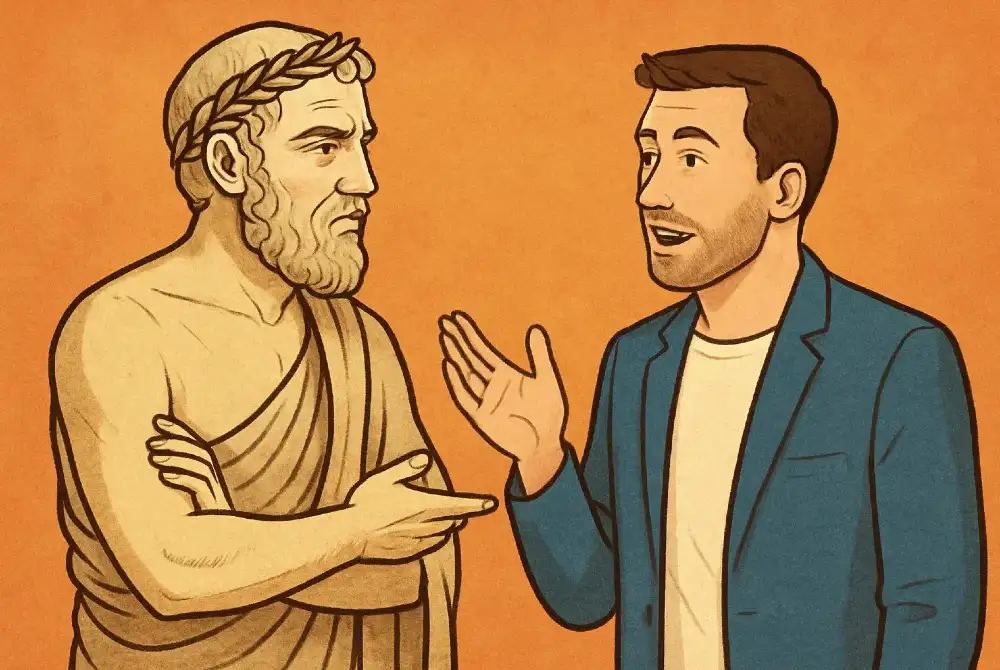
Inner citadel Stoicism is the discipline that carries you through the obstacles no mindset trick or hustle can fix — the terminal diagnosis, the loss, the circumstance that simply will not change. This is where Stoic philosophy stops being a productivity hack and becomes something closer to armor: a way to keep your character intact when nothing else holds.
Some obstacles cannot be overcome through perception or action. No amount of clever reframing or persistent effort will change them. When you’re facing terminal illness, profound loss, or circumstances genuinely beyond your control, you need something deeper than optimism or hard work. You need will.
In The Obstacle Is the Way, Ryan Holiday explores this third and most demanding discipline of Stoic philosophy: the discipline of will. This is where Stoicism reveals its true depth — not as a success strategy, but as a philosophy for enduring life’s inevitable hardships with dignity, meaning, and even joy. Understanding inner citadel Stoicism means understanding that discipline in full.
What Is Inner Citadel Stoicism?
Inner citadel Stoicism is the practice of building an unshakeable inner core — a mental fortress of character, values, and chosen attitude — that external events cannot breach. Rooted in the writings of Marcus Aurelius, it holds that while you cannot always control what happens to you, you can always control who you become in response to it.
That’s the concept in a sentence. The rest of this guide is about what it actually takes to build one.
Understanding the Inner Citadel: Marcus Aurelius’s Fortress Within
The Stoics used the metaphor of an inner citadel — a fortress within your mind that cannot be breached by external events. No matter what happens to you, no matter what you lose or endure, this inner fortress remains yours. It’s the one thing that can never be taken from you without your consent.
Marcus Aurelius wrote extensively about this inner citadel. As emperor, he faced constant threats: war, plague, betrayal, the deaths of his own children. He couldn’t change most of these circumstances, but he could control his response to them. His inner citadel — his character, his principles, his chosen attitude — remained inviolate. It’s a theme that runs through Stoic ethics more broadly; the Stanford Encyclopedia of Philosophy’s entry on Stoicism frames virtue itself as the perfected condition of human reason, entirely within an agent’s own power regardless of external circumstance — which is essentially the philosophical foundation the inner citadel is built on.
Holiday explains that building your inner citadel isn’t about becoming hard or emotionless. It’s about developing an unshakeable core that allows you to maintain your values, your dignity, and your sense of purpose regardless of external circumstances. It’s the difference between breaking and bending, between being destroyed and being tested.
This concept matters more than ever in a culture that constantly tells you that you should be able to control everything through the right technique or the right mindset. Sometimes you can’t. Sometimes life is genuinely tragic, unfair, or painful. The stoic discipline of will is how you endure those times without losing yourself — and it’s a natural extension of the Stoic discipline of perception that turns obstacles into opportunity, applied to the obstacles that perception alone can’t dissolve.
Premeditatio Malorum: The Stoic Discipline of Negative Visualization
One of the most powerful tools for building will is a practice the Stoics called “premeditatio malorum” — the premeditation of evils. Holiday describes this as deliberately imagining worst-case scenarios, not to depress yourself, but to prepare yourself mentally and emotionally for difficulty.
This seems counterintuitive to modern positive thinking, but it’s profoundly practical. By regularly contemplating potential hardships — the loss of your job, the death of loved ones, the failure of your plans — you accomplish several things at once. You prepare yourself emotionally for possibilities rather than being devastated by them. You appreciate what you have more fully because you recognize it won’t last forever. And you identify what truly matters versus what’s merely preferred.
Seneca, the Stoic philosopher, practiced this regularly. He would periodically live as if he’d lost everything — eating simple food, wearing plain clothes, sleeping on the floor. This wasn’t masochism; it was training. He was proving to himself that he could endure hardship if necessary, removing the fear that poverty or loss would destroy him.
Holiday suggests starting small with this practice. Before important meetings, imagine them going poorly. Before trips, imagine cancellations or disasters — not to manifest negativity, but to rob potential disappointments of their power to devastate you. When you’ve already imagined and prepared for the worst, you’re less likely to fall apart when difficulties actually arrive.
Show Image
Amor Fati: Learning to Love Your Fate
Perhaps the most challenging yet transformative concept Holiday explores is “amor fati” — the love of fate. The amor fati meaning goes beyond merely accepting what you cannot change; it’s about genuinely embracing it, finding meaning in it, even loving it.
Friedrich Nietzsche articulated this powerfully: he described amor fati as wanting nothing about your life to be different, not forward, not backward, not in all eternity — not just enduring what’s necessary, but loving it.
This sounds impossible, even absurd. How can you love a terminal diagnosis? How can you embrace betrayal or loss? Holiday makes clear this isn’t about pretending bad things are good. It’s about recognizing that reality is what it is, and your resistance to it only adds suffering without changing the facts.
Thomas Edison’s laboratory burned to the ground, destroying years of work. His response, reportedly, was to see genuine value in the disaster — noting that every mistake had just been burned up, and that there was reason to be grateful for the chance to start again. He didn’t just accept the fire; he found a way to embrace it as an opportunity. That’s amor fati in action.
The practice begins with acceptance: this is what happened. Then it moves to: given that this happened, what meaning can I find? What opportunity exists? How can I use this? Finally, it reaches: I wouldn’t change this even if I could, because it made me who I needed to become.
The Art of Acquiescence: Stoic Acceptance in Practice
Related to amor fati is the practice of acquiescence — willing what happens rather than resisting reality. This doesn’t mean giving up or becoming passive. It means aligning your will with reality rather than fighting battles you cannot win.
Holiday shares the example of James Stockdale, a Navy pilot shot down over Vietnam who spent seven years as a prisoner of war, much of it in solitary confinement and under torture. As his plane was hit and he prepared to eject, Stockdale reportedly told himself he was leaving the world of technology and entering the world of Epictetus.
Epictetus, the Stoic philosopher who had himself been enslaved, taught that we should focus only on what’s within our control and accept what isn’t. Stockdale couldn’t control his imprisonment, the torture, or the years of separation from his family. He could control his response, his attitude, and his behavior toward fellow prisoners.
By accepting his circumstances rather than raging against them, Stockdale preserved his sanity and dignity. He didn’t waste energy on wishful thinking or resentment. Instead, he focused on what he could influence: maintaining discipline, following his code of conduct, helping other prisoners, and surviving with honor.
This practice of acquiescence isn’t resignation — it’s a strategic focus of energy. You acknowledge reality as it is, conserve your resources, and direct them toward what you can actually affect. Fighting unchangeable reality is like swimming against a riptide; acquiescence is swimming parallel to shore until you find a way out.
Finding Meaning in Suffering
Viktor Frankl, a psychiatrist who survived Nazi concentration camps, discovered something profound: those who found meaning in their suffering were more likely to survive than those who didn’t. He later developed an entire therapeutic approach — logotherapy — built on the search for meaning.
Holiday connects this directly to Stoic philosophy. The Stoics believed that while you can’t always control what happens to you, you can always control what it means. You get to decide whether your suffering is pointless or purposeful, whether it diminishes or develops you.
Marcus Aurelius faced unrelenting hardship as emperor — constant war, a plague that killed millions, betrayals, the loss of most of his children. He could have become bitter, angry, or despairing. Instead, he chose to see his difficulties as opportunities to practice virtue. Each challenge was a chance to demonstrate courage, wisdom, justice, and self-discipline.
This is the power of will: the ability to find meaning and purpose even in circumstances you would never choose. Your child’s illness becomes an opportunity to demonstrate love and patience. Your career failure becomes a catalyst for discovering your true calling. Your betrayal becomes a lesson in forgiveness and wisdom about human nature.
The meaning you find doesn’t erase the pain or make the obstacle good. But it transforms suffering from something that destroys you into something that forges you into someone stronger, wiser, and more compassionate.
Perseverance: The Long Game of Stoic Will
Building an inner citadel isn’t a one-time event — it’s a lifelong practice of perseverance. The obstacles that test your will often don’t resolve quickly. They’re chronic illnesses, long careers in difficult circumstances, relationships that require sustained effort, or life conditions that may never change.
Holiday emphasizes that will is demonstrated not in dramatic moments but in the daily grind of continued commitment. It’s getting up every day and facing the same obstacle with the same determination, even when there’s no end in sight — the same underlying muscle that powers the Stoic discipline of action, just applied over years instead of a single push.
He shares the story of Thomas Edison, not just his laboratory fire but his decades of experimentation before success. Edison failed thousands of times, faced mockery and doubt, but persevered. When asked about his failures, he reframed them as the process of finding thousands of ways that simply wouldn’t work.
This long-game perspective is crucial for developing will. You’re not trying to solve everything immediately or overcome every obstacle tomorrow. You’re committing to continue indefinitely, to maintain your principles and purpose regardless of how long it takes or whether you ever see complete victory.
Perseverance means understanding that will is measured over lifetimes, not moments. It’s the accumulated weight of a thousand small decisions to keep going, to maintain standards, to refuse to quit even when quitting would be easier.
Connecting to Something Bigger Than Yourself
One of Holiday’s most powerful insights about will is that it’s strengthened by connection to something larger than yourself. When obstacles threaten to overwhelm you, your individual strength may not be enough. But when you’re fighting for a cause, a principle, a community, or a legacy, you tap into reserves you didn’t know you had.
The Stoics emphasized this through their concept of being part of a larger whole. Marcus Aurelius constantly reminded himself that he was a small part of nature, of humanity, of the cosmos. This wasn’t meant to diminish him but to connect him to something that gave meaning beyond his individual suffering.
When your child is sick, your will to endure is strengthened by love. When you’re fighting for justice, your will perseveres through setbacks because the cause matters more than your comfort. When you’re building something to outlast you, temporary obstacles seem less important.
Holiday suggests identifying what you’re part of that’s bigger than yourself. Maybe it’s your family, your community, your profession, your nation, or humanity itself. Maybe it’s values like truth or justice or beauty. When you connect your will to these larger purposes, you become nearly impossible to break — which is also why so many of the real men who turned devastating setbacks into victory describe their turning point as the moment they stopped fighting for themselves alone.
Memento Mori: Using Mortality to Build Your Inner Citadel
The Stoics regularly practiced “memento mori” — remembering death. This wasn’t morbid or depressing; it was clarifying. When you remember that life is finite, that this obstacle is temporary even if the only guarantee is that you won’t face it forever, everything changes.
Holiday explains that meditating on mortality accomplishes several things. It helps you prioritize what truly matters versus what’s merely urgent. It reminds you that present difficulties, however painful, are temporary. And it motivates action — you don’t have infinite time to overcome obstacles or pursue meaning, so you’d better start now.
Marcus Aurelius’s own writing on this point is direct: he reminded himself that he could leave life at any moment, and that this thought should shape what he did, said, and thought. This wasn’t counsel to live recklessly or to give up. It was a reminder that time is precious and obstacles, while real, shouldn’t prevent you from living according to your values right now.
When facing an obstacle that seems overwhelming, ask yourself: if I had only one year to live, would this obstacle still dominate my thinking? Would I waste my remaining time in resentment or fear? Or would I focus on what matters — love, meaning, virtue, contribution?
This perspective doesn’t make obstacles disappear, but it often makes them smaller relative to what’s truly important. And sometimes, recognizing your mortality gives you the courage to endure difficult circumstances with more grace, knowing that this too shall pass.
Preparing to Start Again
The final aspect of will that Holiday explores is perhaps the most humbling: preparing to start over. Sometimes, despite your best efforts — perfect perception, tireless action, unshakeable will — you don’t overcome the obstacle. You fail. You lose. You have to begin again from scratch, or from somewhere worse than where you started.
Will is what allows you to dust yourself off and start again. It’s what prevented Edison from giving up after the fire, what drove Grant forward through repeated failures, what enabled Stockdale to maintain dignity in circumstances designed to break him.
Holiday emphasizes that starting over isn’t a failure of will — it’s a demonstration of will. The willingness to fail, to lose everything, to face humiliation or defeat, and still continue pursuing what matters — that’s the ultimate expression of the Stoic discipline of will.
Life will knock you down. Obstacles will defeat your plans. Some challenges will break your strategies and leave you with nothing but your character and your commitment. Will is what allows you to accept these realities without despair and to begin again with undiminished effort.
How to Build an Inner Citadel: A Daily Practice
Understanding the inner citadel intellectually is one thing. Building one is another. It isn’t a single decision you make and then forget; it’s a set of habits repeated until they become character. A few concrete starting points:
- Journal each morning or evening. Marcus Aurelius’s Meditations were never meant for publication — they were his own daily practice of reasoning through difficulty. Ten minutes of honest, private writing does more for your inner citadel than any amount of passive reading.
- Run a weekly premeditatio malorum session. Once a week, sit down and deliberately imagine one realistic setback — a lost client, a health scare, a relationship strain — and mentally rehearse your response before it happens.
- Practice voluntary discomfort. Take a cold shower. Skip a meal. Sleep on the floor for a night, the way Seneca did. Small, chosen hardships build the confidence that you can handle larger, unchosen ones.
- Separate what’s yours to control from what isn’t. At the start of each day, name one thing outside your control that you’re tempted to fight, and consciously redirect that energy toward your response instead.
- Anchor to something bigger than the obstacle. Write down the person, cause, or principle you’re enduring for. When will falters, that anchor is often what pulls it back.
None of these practices are dramatic. That’s the point. The inner citadel isn’t built in a single crisis — it’s built in the small, repeated choices that happen long before the crisis arrives.
FAQ: Common Questions About the Stoic Inner Citadel
What does “inner citadel” mean in Stoicism? The inner citadel is a Stoic metaphor, most associated with Marcus Aurelius, for the fortress-like core of character and reasoned judgment within a person that external events cannot touch or control without that person’s consent.
What is the difference between amor fati and acceptance? Acceptance simply means acknowledging that a situation is real and cannot be changed. Amor fati goes further — it asks you to actively embrace and find meaning or even gratitude in that situation, rather than merely tolerating it.
Is Stoic will the same thing as suppressing emotion? No. Holiday and the Stoics themselves are explicit that building an inner citadel is not about becoming emotionless or hard. It’s about maintaining your values and dignity while still feeling — and moving through — real emotion.
How long does it take to build an inner citadel? There’s no fixed timeline. The Stoics treated it as a lifelong practice rather than a destination, built through daily habits like journaling, negative visualization, and voluntary discomfort rather than achieved once and forgotten.
What’s a simple way to start practicing premeditatio malorum? Pick one realistic, moderate setback you might face this week — a difficult conversation, a possible delay, a piece of bad news — and spend five minutes imagining it happening and how you’d respond with composure.
Conclusion: The Ultimate Discipline
Ryan Holiday places the discipline of will last in The Obstacle Is the Way because it’s both the final resort and the ultimate foundation. When perception and action aren’t enough, will is what remains. But will also underlies and enables everything else — you need will to maintain clear perception when reality is painful, and you need will to sustain persistent action when results don’t come. If you haven’t read the complete framework behind Holiday’s book, it’s worth seeing how all three disciplines — perception, action, and will — fit together, and how Stoic wisdom applies to distinctly modern problems well beyond ancient Rome.
Building your inner citadel isn’t easy. It requires regular practice, honest self-examination, and a willingness to face difficult truths about life’s uncertainty and unfairness. But it’s the only true security in an insecure world.
Your obstacles — whatever they are — will test your will. Some will test it more severely than you ever imagined possible. Your response to that test, your ability to endure while maintaining your values and dignity, will define who you become.
Inner citadel Stoicism doesn’t promise that hardship will disappear. It promises that character, once built through negative visualization, amor fati, acceptance, and a purpose bigger than yourself, becomes the one thing no obstacle can take from you. Build it now, before you desperately need it — because when the inevitable obstacles come that cannot be changed through perception or overcome through action, your will has to be enough. And if you’ve built it well, it will be.
Related posts:
 The Obstacle Is the Way Summary: Ryan Holiday’s Complete Framework
 How Stoicism Turns Obstacles Into Opportunity: Lessons From The Obstacle Is the Way
 Stoicism in Modern Life: How Ancient Wisdom Solves Modern Problems
 The Real Stories Behind Stoic Philosophy: People Who Transformed Devastating Setbacks Into Victory
 The Stoic Discipline of Perception: How to See Obstacles Clearly