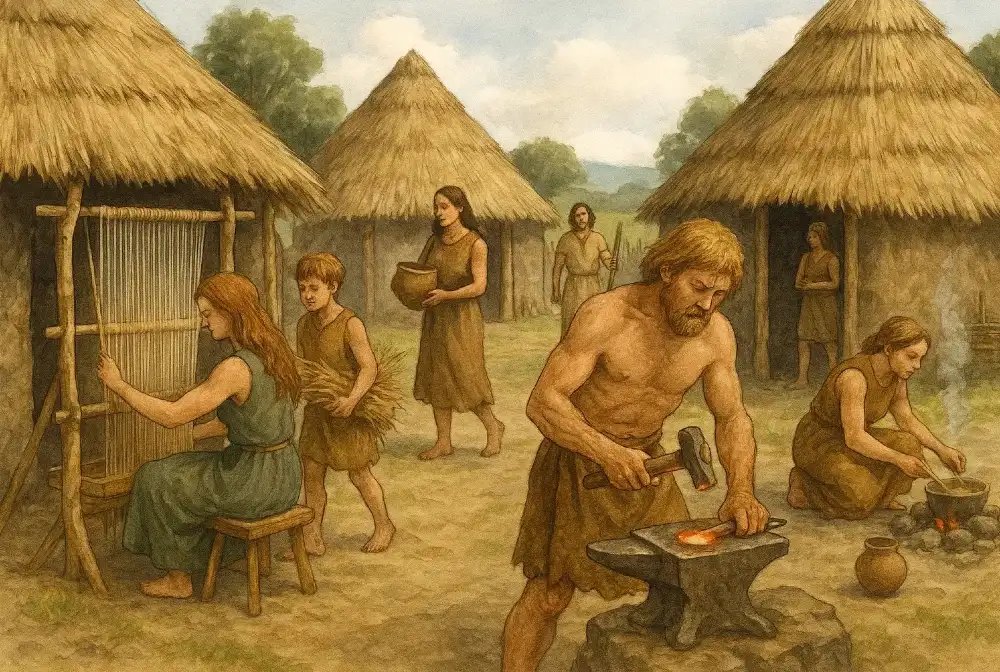
When Bronze Age empires collapsed around 1177 BC, survival often depended less on grand strategies than on local community resilience. While palace bureaucracies crumbled and international networks failed, some communities maintained cohesion, supported members, and rebuilt from devastation. Eric H. Cline‘s “After 1177 B.C.: The Survival of Civilizations” reveals how community-level resilience enabled survival during catastrophic disruption. Modern neighborhoods, towns, and cities facing climate change, economic uncertainty, and social fragmentation can apply these ancient community-building principles.
Why Community Resilience Matters More Than Ever
Bronze Age collapse demonstrated that when large-scale systems fail, survival depends on local communities. Imperial armies couldn’t protect every village. Palace redistribution systems couldn’t feed every household. International trade couldn’t supply every community. In such circumstances, local resilience—neighbors helping neighbors, communities sharing resources, local leaders maintaining order—determined who survived.
Modern society faces similar dynamics despite different scales. Global supply chains prove vulnerable to disruption. National governments struggle to respond quickly to local crises. Economic systems fail individuals even as aggregate statistics suggest prosperity. In such contexts, community resilience provides essential support that larger systems can’t or won’t deliver.
Cline’s research shows that Bronze Age communities with strong social bonds, local resource production, effective local leadership, and adaptive capacity weathered collapse better than those depending entirely on external systems. These same factors determine modern community resilience. Neighborhoods with strong social networks, local food systems, community leadership, and problem-solving capacity navigate disruptions more successfully than atomized, disconnected communities.
The COVID-19 pandemic demonstrated community resilience principles in action. Communities with strong social connections organized mutual aid, shared resources, and supported vulnerable members. Those lacking such connections experienced more severe impacts. The difference wasn’t just economic but social—communities functioned as communities or failed as collections of isolated individuals.
Building Social Capital Through Daily Interaction
Bronze Age communities maintained resilience partly through dense social networks. Everyone knew neighbors, participated in community activities, and maintained relationships across extended families. These connections provided information networks, mutual support systems, and social cohesion enabling collective action during crises.
Modern urban and suburban life often involves anonymity and isolation. People don’t know neighbors, avoid community involvement, and interact primarily through screens rather than face-to-face. This social fragmentation creates vulnerability—when crisis comes, atomized individuals lack community support systems.
Building community social capital starts simply: know your neighbors. Introduce yourself, exchange contact information, participate in neighborhood activities. This sounds trivial but creates foundations for resilience. When disasters strike, connected neighbors check on each other, share resources, and coordinate responses. Isolated individuals struggle alone.
Beyond immediate neighbors, participate in community organizations, attend local meetings, volunteer for community projects, and patronize local businesses. These activities build social connections creating community fabric. They transform geographical proximity into genuine community—people who know and support each other rather than strangers who happen to live nearby.
The Bronze Age shows that social capital requires ongoing investment. Communities that maintained regular gatherings, shared ceremonies, and collective activities developed bonds that proved crucial during crises. Modern equivalents include neighborhood associations, community events, local sports leagues, community gardens, and faith communities. These activities build relationships that otherwise wouldn’t exist.
Developing Local Food and Resource Systems
When Bronze Age trade networks collapsed, communities depending entirely on imports faced starvation. Those maintaining local agricultural production, food storage, and resource diversity could feed themselves despite disruption. This local resilience proved crucial for survival during extended crises.
Modern communities face similar vulnerabilities. Most urban and suburban areas depend on complex supply chains delivering food from distant sources. When these systems function normally, they provide abundance and variety. However, disruptions—whether from climate events, economic shocks, or pandemics—quickly create shortages.
Building local food resilience doesn’t require complete self-sufficiency but does involve reducing dependence on distant supply chains. This includes supporting local farmers markets, participating in community gardens, maintaining home gardens when possible, and supporting local food businesses. Even modest local production provides buffers during supply chain disruptions.
Community-level initiatives like community gardens, food cooperatives, and neighborhood crop-sharing create local food networks that strengthen resilience. These initiatives also build social capital—people working together in gardens develop relationships extending beyond gardening. The food production provides practical benefits while community-building provides social resilience.
Bronze Age examples suggest that diversified local resources matter beyond just food. Communities with access to water, fuel, building materials, and essential tools maintained greater independence from external systems. Modern applications include community tool libraries, seed exchanges, renewable energy cooperatives, and local repair networks. These create resource diversity reducing dependence on centralized systems.
Cultivating Community Leadership and Decision-Making
Bronze Age communities that maintained effective local leadership navigated crises more successfully than those lacking it. When higher authorities disappeared during collapse, communities with capable local leaders could organize responses, mediate disputes, and coordinate collective action. Those lacking such leadership often fragmented into conflict or paralysis.
Modern communities similarly need effective local leadership independent of formal government positions. This includes neighborhood organizers, community advocates, nonprofit leaders, and informal community connectors who take initiative during challenges. These leaders emerge from community involvement and demonstrate capability through action.
However, resilient communities don’t depend on single leaders—they cultivate distributed leadership with multiple people capable of initiative. Bronze Age examples show that communities depending on single leaders faced vulnerability if those leaders failed. Distributed leadership provides redundancy and shares responsibility.
Building community leadership capacity involves encouraging participation, providing leadership opportunities, and developing governance structures enabling collective decision-making. Neighborhood associations, community committees, and local planning processes all create frameworks for distributed leadership. These structures prove especially valuable during crises when rapid collective action becomes necessary.
The key involves moving beyond passive consumption of community to active participation in creating it. Bronze Age communities where everyone contributed proved more resilient than those with passive majorities and active minorities. Modern communities need similar broad participation—not everyone needs to lead, but everyone should contribute somehow.
Creating Community Communication Networks
When Bronze Age palace communication systems collapsed, communities maintaining local information networks could coordinate responses and share intelligence. Those lacking such networks struggled with rumor, panic, and inability to coordinate action. Effective communication proved essential for resilient communities.
Modern communities need communication systems independent of centralized infrastructure. Social media and internet provide connectivity during normal times but prove vulnerable during power outages, network failures, or deliberate disruption. Communities with backup communication systems—email lists, text networks, phone trees, or even physical message boards—maintain coordination capacity when primary systems fail.
Beyond technology, face-to-face communication through regular community meetings creates information exchange and relationship maintenance. Bronze Age communities gathered regularly for markets, ceremonies, and assemblies. These gatherings provided information exchange alongside social bonding. Modern equivalents include neighborhood meetings, community events, and regular gathering spaces.
Effective community communication also requires trusted information sources. During Bronze Age crises, communities with recognized leaders or councils providing reliable information could counter rumors and coordinate responses. Modern communities need similar trusted sources—whether neighborhood associations, community organizations, or respected community members—who can provide accurate information during crises.
Building Economic Resilience Through Local Exchange
Bronze Age communities maintained economic resilience partly through local exchange networks. When long-distance trade collapsed, local markets and barter systems continued. Communities with diverse local economic activities could maintain exchange even when currencies failed or external markets disappeared.
Modern communities can build similar economic resilience through local exchange systems, community currencies, time banks, and mutual aid networks. These create economic activity independent of larger financial systems. During economic downturns, communities with robust local exchange maintain more economic activity than those entirely dependent on external economies.
Supporting local businesses strengthens community economic resilience. Money spent locally tends to recirculate within communities multiple times, multiplying economic impact. Local businesses also provide employment to community members and often demonstrate stronger commitment to community welfare than distant corporations.
Some communities experiment with local currencies or time banking systems where services are exchanged based on time rather than money. While these don’t replace normal currency, they create backup systems enabling exchange during financial crises. Bronze Age barter systems served similar functions when currency systems failed.
Developing Community Skills and Knowledge
Bronze Age communities that preserved critical skills—metalworking, agriculture, construction, textile production—maintained greater self-sufficiency than those losing such knowledge. When specialized craftsmen serving palace economies disappeared, communities with diverse local skills could maintain production of essential goods.
Modern communities face similar vulnerabilities as specialized skills concentrate in distant locations. Few community members know how to repair equipment, grow food, build structures, or produce essential goods. This creates dependence on external experts and systems. When those systems fail, communities lack capacity for basic self-provisioning.
Building community skill resilience involves skill-sharing initiatives, community workshops, and apprenticeship programs. Tool libraries with training programs teach repair and maintenance skills. Community gardens provide agricultural education. Maker spaces offer technical and craft skill development. These initiatives distribute knowledge across communities rather than concentrating it in specialists.
Intergenerational knowledge transfer also matters. Bronze Age communities maintaining oral traditions and apprenticeship systems preserved essential knowledge through disruptions. Modern communities can create formal and informal mentoring relationships ensuring older generations transfer skills and knowledge to younger members.
Creating Community Emergency Preparedness
Bronze Age communities that maintained food stores, defensive preparations, and disaster response capabilities weathered crises better than unprepared ones. This preparedness didn’t guarantee avoiding all harm but significantly improved outcomes during inevitable disruptions.
Modern communities need similar emergency preparedness at collective level beyond just individual household preparations. This includes community emergency response teams, neighborhood evacuation plans, vulnerable population registries for welfare checks, emergency shelter agreements, and community resource inventories identifying available skills and supplies.
Some communities organize Community Emergency Response Team (CERT) training preparing residents for disaster response. Others create neighborhood emergency plans coordinating responses to fires, floods, earthquakes, or other disasters. These preparations prove invaluable during actual emergencies enabling rapid coordinated response.
Preparedness also involves identifying vulnerable community members—elderly, disabled, isolated individuals—ensuring they receive assistance during emergencies. Bronze Age communities maintained awareness of vulnerable members and social obligations for their care. Modern communities can formalize these practices through registry systems and support networks.
Maintaining Cultural Identity and Cohesion
Bronze Age communities that maintained strong cultural identities—shared languages, religious practices, traditions—demonstrated greater cohesion during crises. Shared identity created social bonds facilitating cooperation and mutual support. Communities lacking such cohesion more easily fragmented under stress.
Modern communities benefit from cultivating shared identity while respecting diversity. This involves community traditions, shared spaces, collective rituals, and common narratives about community character and values. These cultural elements create cohesion without requiring uniformity.
Community celebrations, festivals, and commemorations all contribute to shared identity. Bronze Age communities gathered for harvest festivals, religious ceremonies, and seasonal celebrations reinforcing social bonds. Modern community events serve similar functions—creating shared experiences and traditions that bind people together.
However, modern communities must balance shared identity with inclusion of diverse populations. Bronze Age communities were generally more homogeneous than contemporary ones. Modern community building requires creating inclusive identities celebrating diversity while maintaining enough commonality for cohesion. This represents a challenge but also an opportunity for richer, more resilient communities.
Practical Steps for Building Community Resilience
Understanding these principles matters less than implementing them. Bronze Age survivors succeeded through action, not merely knowledge. Modern community members similarly must move from awareness to engagement.
Start simply: introduce yourself to neighbors, attend one community meeting, volunteer for one local initiative. These small actions begin building relationships and involvement that compound over time. Community resilience develops incrementally through sustained engagement, not dramatic gestures.
Identify existing community assets—people, organizations, spaces, resources—that can be strengthened and connected. Most communities have more assets than residents realize. Successful community building often involves better utilizing existing resources rather than creating everything from scratch.
Create or join community organizations focused on specific resilience elements—food security, emergency preparedness, skill-sharing, mutual aid, or local economy. Focused initiatives provide concrete activities while contributing to broader resilience goals.
Advocate for public policies supporting community resilience—community space investment, local food system support, neighborhood empowerment, and distributed infrastructure. Individual and community actions matter, but supportive policies multiply their effectiveness.
The Role of Local Government
While this article emphasizes community-level action, local government plays crucial roles in enabling or hindering community resilience. Bronze Age examples show that effective local governance complemented rather than replaced community initiative. The best outcomes resulted from partnerships between government and community action.
Modern local governments can support community resilience by providing resources, removing barriers to community initiatives, creating frameworks for community participation, and implementing policies prioritizing resilience. However, communities shouldn’t wait for government action—Bronze Age examples show that resilient communities often developed despite rather than because of governmental systems.
The key involves communities taking initiative while seeking governmental partnership and support. This creates resilient communities less dependent on any single actor—whether government or grassroots—for all resilience functions.
Overcoming Barriers to Community Engagement
Many modern people face genuine barriers to community involvement—time constraints, family obligations, economic pressures, social anxiety, or simply not knowing how to begin. Bronze Age communities didn’t face identical barriers but had their own challenges coordinating collective action.
Overcoming modern barriers requires both individual effort and community accommodation. Individuals must prioritize some time for community engagement despite competing demands. Communities must create accessible participation opportunities accommodating various schedules, abilities, and comfort levels.
Start where you are with what you have. Bronze Age survivors didn’t wait for ideal conditions before building resilience—they worked with available resources and opportunities. Modern community builders can adopt similar pragmatism, starting small and building incrementally rather than waiting for perfect circumstances.
Measuring Community Resilience
How do you know if community resilience efforts succeed? Bronze Age examples suggest several indicators: strong social networks where people know and help neighbors, local resource systems providing some independence from external supply chains, effective communication systems enabling coordination, distributed leadership with multiple capable community organizers, and demonstrated capacity responding to actual challenges.
Regular community resilience assessments can identify strengths and gaps. This might involve community meetings discussing resilience, surveys measuring social connection, audits of local resources and skills, or review of responses to recent challenges. These assessments inform priorities for continued resilience building.
However, the ultimate test comes during actual crises. Bronze Age community resilience proved itself when collapse actually occurred. Modern communities demonstrate resilience by effectively navigating real challenges—whether natural disasters, economic downturns, or social crises. These experiences reveal both strengths to celebrate and gaps requiring attention.
The Power of Community Action
Eric H. Cline‘s “After 1177 B.C.: The Survival of Civilizations” demonstrates that empires may fall but resilient communities endure. When Bronze Age palace systems collapsed, local communities with strong social bonds, capable leadership, local resources, and adaptive capacity survived and eventually rebuilt. These same principles determine modern community resilience.
The lesson isn’t that community action solves all problems—it doesn’t. Bronze Age communities still faced tremendous hardship during and after collapse. However, resilient communities navigated challenges more successfully than fragmented ones. They provided mutual support, coordinated responses, maintained social order, and created foundations for eventual recovery.
Modern communities facing their own uncertainties—climate change, economic instability, social fragmentation, technological disruption—need similar resilience. Building this resilience requires moving beyond passive individualism to active community participation. It means knowing neighbors, supporting local initiatives, developing local resources, cultivating community leadership, and maintaining social bonds.
The choice facing modern communities mirrors that faced by Bronze Age ones: build resilience proactively during relatively stable times or desperately improvise during crisis. Bronze Age examples consistently show that proactive community building from strength proves far more effective than reactive scrambling from weakness.
Community resilience doesn’t happen automatically—it results from deliberate choices by community members prioritizing connection over isolation, cooperation over pure individualism, and long-term community building over short-term convenience. These choices, made by enough people over sufficient time, create genuinely resilient communities capable of weathering whatever challenges future brings.
The survival of civilizations ultimately depends not just on grand strategies and powerful institutions but on resilient communities maintaining social bonds, mutual support, and collective capacity during both good times and bad. Three thousand years ago and today, this remains the foundation of lasting resilience.
Related posts:
 1177 B.C. Explained: What the Bronze Age Collapse Teaches Modern Civilization
 7 Bronze Age Survival Strategies That Still Work in Modern Life
 Organizational Resilience Strategies: What the Bronze Age Collapse Teaches Modern Business
 How Bronze Age Globalization Collapsed in Just 50 Years: Lessons for Today (Goliath`s Curse by Luke Kemp)
 What Ancient Societies Teach Us About Resilience: The Adaptive Cycle Framework