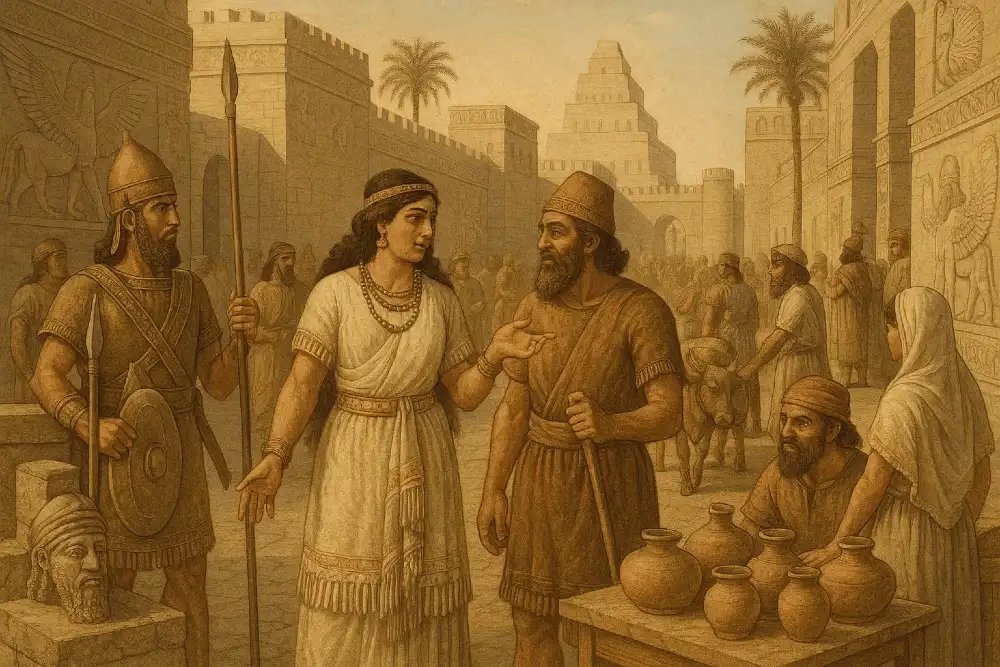
While most Bronze Age civilizations collapsed around 1177 BC, the Assyrian Empire not only survived but eventually dominated the ancient Near East for centuries. Eric H. Cline’s “After 1177 B.C.: The Survival of Civilizations” reveals how Assyrian military innovation, administrative efficiency, and aggressive expansion transformed them from a minor regional power into history’s first true superpower. Their success story demonstrates that resilience sometimes requires decisive, even ruthless, adaptation to changed circumstances.
Assyria Before the Collapse
Unlike the Hittites, Mycenaeans, or Egyptians, Assyria wasn’t among the Bronze Age’s dominant powers. The Middle Assyrian Kingdom controlled territories in northern Mesopotamia but remained secondary to greater powers like the Hittite Empire and Mittani. Assyrian kings maintained their state through efficient administration and military competence, but they lacked the resources and influence of larger empires.
This secondary status paradoxically positioned Assyria advantageously when the Bronze Age system collapsed. Major powers invested heavily in maintaining international networks and palace economies that proved vulnerable to systemic disruptions. Assyria’s smaller scale and more compact territory provided inherent resilience. When the interconnected Bronze Age world fragmented, Assyria’s relative isolation from collapse epicenters gave them breathing room.
Archaeological evidence shows Assyria experienced disruptions during the twelfth century BC but avoided the catastrophic collapse that destroyed other states. Trade routes were disrupted, some territories were lost, and economic challenges emerged. However, the fundamental Assyrian state survived intact. This continuity allowed them to maintain organizational capabilities and institutional knowledge that other societies lost.
Military Innovation and Professionalization
The key to Assyrian resilience and subsequent dominance was military innovation. During the eleventh and tenth centuries BC, Assyrian rulers fundamentally transformed their military organization, creating the ancient world’s most effective fighting force. These innovations gave Assyria decisive advantages over neighboring states still recovering from Bronze Age collapse.
Cline’s research highlights several crucial military developments. The Assyrians pioneered iron weapons and tools at scale, giving them technological superiority over opponents using bronze. They developed siege warfare techniques including battering rams, siege towers, and engineering corps capable of taking heavily fortified cities. They organized cavalry and chariot units with unprecedented coordination. These tactical innovations made Assyrian armies virtually unstoppable.
Equally important was military professionalization. Unlike Bronze Age armies that relied heavily on seasonal levies and citizen-soldiers, Neo-Assyrian forces included large standing armies of professional soldiers. These troops received regular training, standardized equipment, and systematic tactical instruction. Professional soldiers could campaign year-round rather than only between agricultural seasons, giving Assyria strategic flexibility unavailable to opponents.
The Assyrian military system also featured sophisticated logistics and engineering. Royal inscriptions describe elaborate preparations for campaigns including road construction, bridge building, and supply depot establishment. Assyrian armies could operate effectively in diverse terrain from mountains to deserts. This logistical capability enabled sustained campaigns far from Assyrian heartlands, essential for imperial expansion.
Administrative Efficiency and Imperial Organization
Military prowess alone wouldn’t have sustained Assyrian dominance for centuries. Equally crucial was administrative innovation that allowed effective governance of conquered territories. The Neo-Assyrian Empire developed bureaucratic systems that set precedents for all subsequent Near Eastern empires including the Persians and ultimately Alexander the Great’s successors.
Assyrian administration featured several key innovations. They divided territories into provinces governed by appointed officials answerable to the king. These governors collected taxes, maintained order, and mobilized resources for royal projects. Regular reporting requirements and inspection systems prevented provincial governors from becoming autonomous regional powers threatening central authority.
Communication networks connected this administrative system. Assyrian kings established royal road networks with way stations enabling rapid message transmission across the empire. Standardized Akkadian language and cuneiform script facilitated administration across linguistically diverse territories. These systems allowed central authorities to monitor provinces and respond to emerging challenges before they became serious threats.
The Assyrian approach to conquered peoples balanced coercion and incorporation. Royal inscriptions emphasize brutal reprisals against rebels, including deportations, executions, and property destruction. These harsh measures deterred resistance and spread fear throughout the empire. However, Assyria also offered incentives for cooperation including protection, reduced tribute for compliant cities, and opportunities for local elites to maintain status by serving imperial administration.
Deportation Policy and Population Management
One of the most distinctive and controversial Assyrian practices was systematic deportation of conquered populations. Kings regularly resettled entire communities far from their homelands, replacing them with populations from other regions. Royal inscriptions boast about numbers of deportees—sometimes hundreds of thousands of people moved in single campaigns.
This policy served multiple strategic purposes. It broke up resistant populations by dispersing them across the empire. It prevented conquered communities from organizing rebellions by removing them from familiar terrain and support networks. It populated frontier regions with groups lacking local ties who depended on imperial authority for security. It also redistributed labor to areas needing agricultural workers or craftsmen.
Cline notes that while brutal by modern standards, deportation policy was effective for maintaining imperial control. Deportees weren’t typically enslaved—they received land and resources to rebuild lives in new locations. Many eventually integrated into imperial society, providing tax revenue and military recruits. The policy converted potentially rebellious populations into productive imperial subjects while simultaneously devastating areas that resisted Assyrian authority.
The deportation system also created unprecedented cultural mixing. Assyrian cities became remarkably cosmopolitan, featuring populations from across the empire. This diversity contributed to cultural dynamism and economic innovation. Markets in Assyrian cities offered goods from throughout the Near East. Craftsmen brought diverse technical traditions that cross-fertilized. The empire became a melting pot facilitating exchange and integration.
Royal Ideology and Propaganda
Assyrian kings developed sophisticated ideological frameworks justifying imperial expansion and harsh policies. Royal inscriptions consistently portrayed military campaigns as divinely sanctioned missions to extend civilization and proper order. The god Ashur commanded kings to conquer territories and punish rebels. Resistance to Assyria meant rebellion against divine will deserving extreme punishment.
This ideology served multiple functions. It motivated Assyrian armies by framing campaigns as righteous missions rather than simple conquest. It justified harsh treatment of conquered peoples as divine punishment for disobedience. It portrayed the king as Ashur’s chosen instrument, legitimating royal authority. The ideology created coherent narrative explaining and justifying imperial actions.
Propaganda reinforced this ideological framework. Palace reliefs depicted military victories in vivid detail, emphasizing Assyrian power and enemy defeat. Royal inscriptions recounted conquests and listed tribute from subject peoples. These materials weren’t merely records but propaganda demonstrating imperial might to both subjects and visitors. The Assyrian capital Nineveh featured monumental architecture designed to overawe visitors with imperial grandeur.
The psychological impact of Assyrian propaganda shouldn’t be underestimated. Cities facing Assyrian sieges knew detailed accounts of others’ destruction. The choice between submission with its deportations and tribute versus resistance with its massacres and total devastation created powerful incentives for surrender. Assyrian reputation for overwhelming force and brutal reprisals often achieved victories before armies arrived.
Economic Integration and Trade Networks
Beyond military and administrative systems, Assyrian success depended on economic integration. The empire created vast trading networks connecting diverse regions from the Mediterranean to the Persian Gulf. This integration generated wealth supporting military and administrative expenses while creating economic incentives for cooperation with imperial rule.
Assyrian control of trade routes proved particularly valuable. The empire dominated overland routes connecting Mesopotamia with the Levant, Anatolia, and Egypt. They controlled access to resources including metals, timber, and luxury goods from various regions. This economic leverage gave Assyria influence beyond direct territorial control. States wanting access to trade networks had incentives to maintain positive relations.
The empire also promoted economic development in controlled territories. Assyrian investments in irrigation systems, agricultural infrastructure, and urban development increased productivity. While tribute extraction was substantial, economic development generated surplus allowing both imperial revenue and improved local conditions. This created stakeholders in imperial stability even among conquered populations.
Royal support for crafts and industry contributed to economic dynamism. Assyrian cities became centers for metalworking, textile production, and other specialized industries. Royal workshops produced luxury goods for palace use and diplomatic gifts. The concentration of craftsmen and resources in imperial centers created innovation hubs where techniques and knowledge could cross-fertilize.
Climate Factors in Assyrian Success
Cline emphasizes environmental factors in Assyrian resilience and expansion. Climate data indicates Mesopotamia experienced improved conditions around 925 BC, with increased rainfall supporting agricultural recovery. This environmental shift coincided with Neo-Assyrian imperial expansion under kings like Ashurnasirpal II and Shalmaneser III.
Wetter conditions enabled agricultural surplus that could support larger populations and armies. Improved harvests generated revenue for military campaigns and administrative expenses. Environmental conditions favorable to Mesopotamian agriculture disadvantaged regions still experiencing drought, creating relative advantages for Assyrian expansion. Climate wasn’t the only factor explaining Assyrian success, but it created favorable conditions that effective leadership could exploit.
The Assyrian response to improved climate demonstrates how resilience involves recognizing and exploiting opportunities, not just withstanding stress. When conditions improved, Assyrian rulers had organizational capabilities and military innovations ready to capitalize on favorable circumstances. Other societies facing similar environmental improvements but lacking institutional capacity or strategic vision didn’t achieve comparable success.
Cultural Achievements
While known primarily for military conquests, Assyrian civilization produced significant cultural achievements. Royal libraries, particularly Ashurbanipal’s collection at Nineveh, preserved thousands of cuneiform tablets including literature, science, and administrative records. This library became one of history’s most important sources for understanding ancient Mesopotamian civilization.
Assyrian art reached impressive sophistication, particularly in palace reliefs depicting military campaigns, royal hunts, and court ceremonies. These reliefs combined artistic skill with narrative complexity, telling detailed stories through sequential images. Assyrian sculptors also created monumental statues and architectural elements including the iconic lamassu—winged human-headed bulls guarding palace entrances.
Scientific and technical knowledge flourished under imperial patronage. Assyrian astronomers made detailed celestial observations. Physicians compiled medical texts. Engineers developed sophisticated techniques for irrigation, construction, and siege warfare. Royal support for specialists and concentration of resources in imperial centers facilitated knowledge advancement.
The Empire’s Eventual Collapse
Despite centuries of dominance, the Neo-Assyrian Empire ultimately collapsed in the late seventh century BC. A coalition of Babylonians and Medes destroyed Assyrian power, sacking Nineveh in 612 BC. Within decades, the empire that had dominated the Near East for centuries disappeared from history.
Several factors contributed to this collapse. Over-extension strained imperial resources as the empire expanded to maximum territorial limits. Succession disputes weakened central authority. Conquered populations never fully accepted Assyrian rule, requiring continuous military force to maintain control. When military setbacks occurred, the system that depended on perceived invincibility rapidly unraveled.
Cline notes similarities between Assyrian collapse and the earlier Bronze Age catastrophe. Both involved multiple simultaneous stresses overwhelming system capacity. Both demonstrated how resilience has limits—even highly effective organizations eventually face challenges exceeding their adaptive capacity. The Assyrian example shows that past success doesn’t guarantee future survival when circumstances change fundamentally.
Lessons from Assyrian Resilience
The Assyrian experience offers important lessons about resilience and adaptation. First, survival sometimes requires aggressive rather than defensive strategies. Assyria didn’t merely survive the Bronze Age collapse—they exploited disruption to eliminate competitors and expand power. This offensive approach to crisis management contrasts with more conservative responses by other societies.
Second, organizational capabilities determine how effectively societies can exploit opportunities. When environmental conditions improved around 925 BC, Assyria had military and administrative systems ready to capitalize. Resilience involves not just weathering challenges but positioning to exploit favorable changes when they emerge.
Third, military and administrative innovation can compensate for resource disadvantages. Assyria lacked Egypt’s wealth or Phoenicia’s maritime advantages but created sophisticated organizational systems that leveraged available resources effectively. Innovation in organization and tactics can sometimes overcome material disadvantages.
Fourth, long-term success requires continuous adaptation. The Neo-Assyrian Empire that dominated the eighth and seventh centuries BC bore little resemblance to the Middle Assyrian Kingdom of the Bronze Age. Continuous evolution of military, administrative, and economic systems maintained Assyrian competitiveness for centuries.
Modern Parallels
Assyrian resilience strategies resonate with contemporary challenges, though their harsh methods aren’t models for modern societies. The principle of transforming crises into opportunities, developing organizational capabilities before they’re urgently needed, and maintaining adaptive capacity through continuous innovation all remain relevant.
The Assyrian emphasis on logistics, communication networks, and administrative efficiency influenced all subsequent empires and remains crucial for modern organizations. Their demonstration that smaller states with superior organization can overcome larger but less efficient competitors offers lessons for contemporary geopolitics and business competition.
However, the Assyrian example also warns about over-reliance on military force and coercion. Their empire ultimately collapsed partly because subject peoples never fully accepted Assyrian rule. Sustainable systems require not just effective coercion but also creating stakeholders who benefit from system stability. The contrast between Assyrian coercion and Phoenician partnership models illustrates different paths to influence and power.
Conclusion
Eric H. Cline’s “After 1177 B.C.: The Survival of Civilizations” reveals the Neo-Assyrian Empire as perhaps the most successful example of resilience and recovery following the Bronze Age Collapse. From relatively minor regional power to dominant Near Eastern empire, Assyria’s transformation demonstrates how military innovation, administrative efficiency, and aggressive exploitation of opportunities can enable not just survival but ascendance.
The Assyrian success story illustrates that resilience strategies differ based on circumstances, resources, and values. While Phoenicians succeeded through commercial networks and Greeks through political innovation, Assyria achieved dominance through military prowess and administrative sophistication. Each path proved viable in its own context.
For modern societies facing complex challenges, the Assyrian example offers both inspiration and caution. Their organizational innovations and ability to capitalize on opportunities demonstrate human capacity for adaptation and recovery. However, their eventual collapse after centuries of dominance reminds us that even highly successful systems face limits. True resilience requires not just surviving immediate challenges but building adaptable institutions capable of navigating whatever future brings.
Related posts:
 1177 B.C. Explained: What the Bronze Age Collapse Teaches Modern Civilization
 7 Bronze Age Survival Strategies That Still Work in Modern Life
 Why Bronze Age Villages Survived When Powerful Empires Fell
 Organizational Resilience Strategies: What the Bronze Age Collapse Teaches Modern Business
 Why Were the Phoenicians Such Successful Traders?